
From BWXT to City Hall: Nat Marshall on Education, Workforce, Public Safety and the Choices Facing Lynchburg
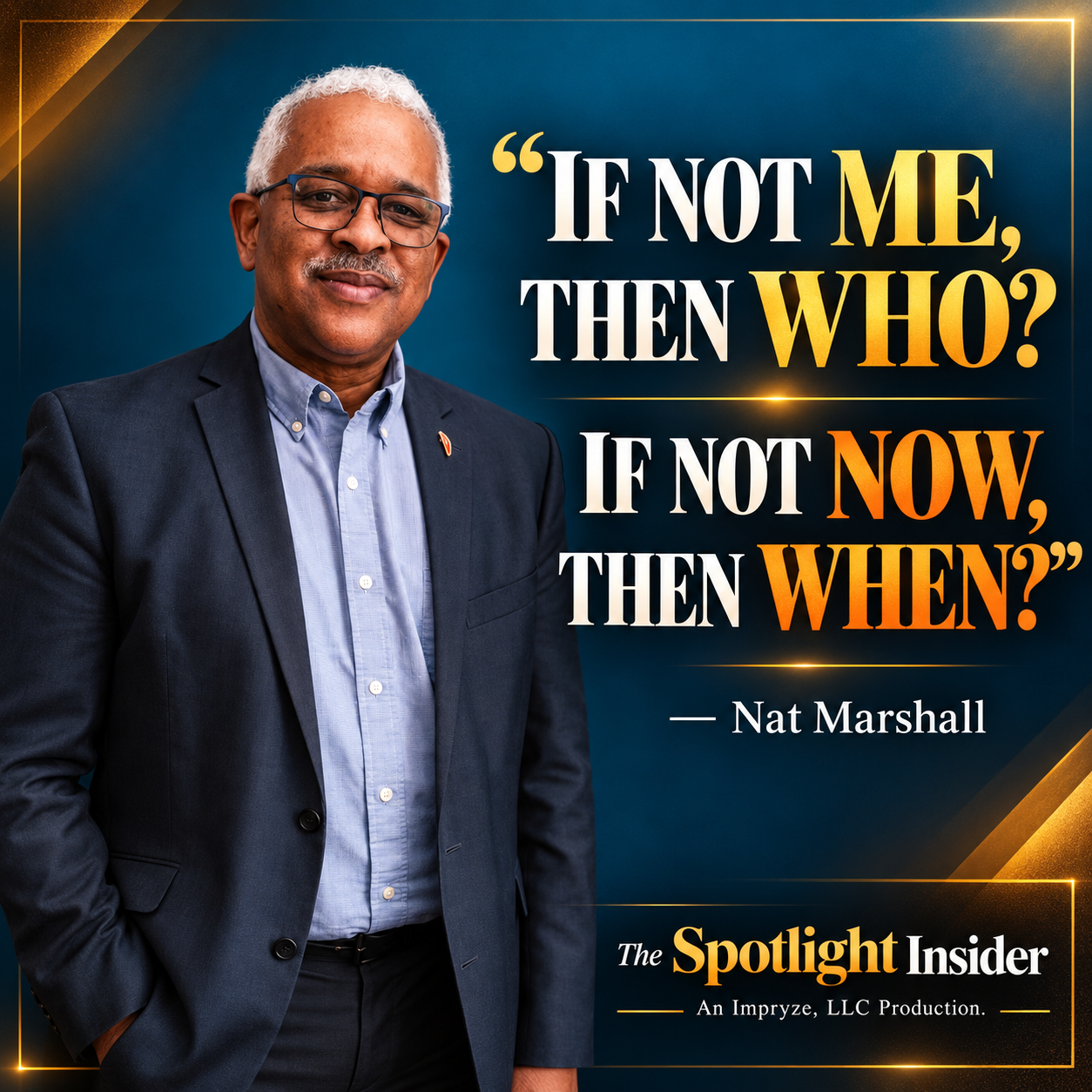
After 41 years at BWXT and decades of board and community service, Nat Marshall is asking Lynchburg voters to give him a different kind of responsibility. In a wide-ranging conversation on The Spotlight Insider, he explained why retirement did not last long, why education sits at the center of his campaign, and how he believes his experience could translate to City Council.
⏯️ WATCH THE FULL INTERVIEW
For Nathaniel “Nat” X. Marshall, retirement was supposed to provide a chance to slow down.
After more than four decades at BWXT, a professional life that included human resources, workforce development, strategic planning, community relations, and partnerships throughout Central Virginia, Marshall had reason to believe the next chapter might finally involve less responsibility.
Then people began asking him to run for Lynchburg City Council.
His first answer was essentially no.
“I just retired,” Marshall recalled during his interview on The Spotlight Insider. He said he needed time to rest and think. The question did not disappear, however. Months later, neither did the sense that he might still have something to contribute.
Eventually, Marshall returned to a mantra that had followed him through much of his professional and community life:
“If not me, then who? And if not now, then when?”
That decision has put Marshall on the ballot in one of Lynchburg’s most consequential local elections of 2026. Voters will choose three at-large City Council members on November 3. Lynchburg operates with a seven-member council, four members elected from wards and three elected citywide. Early voting began September 18.
Marshall is running as a Democratic candidate alongside Christina Delzingaro and Dave Henderson through Lynchburg Better Together. But his argument for office is built less around a partisan identity than around a résumé that stretches across corporate leadership, education, nonprofits, workforce development, youth programs, and institutional boards.
A Central Virginia Life Before Politics
Marshall’s path to City Council did not begin in politics.
He was born and raised in Bedford County and attended Jefferson Forest High School before attending the University of Lynchburg, then Lynchburg College. He earned degrees in Business Administration and English. The university later awarded him an honorary Doctor of Humane Letters.
His upbringing, as Marshall described it on The Spotlight Insider, was financially modest. His father worked as a custodian and his mother as a hostess. The family lived in rural Bedford County, and their home initially lacked indoor plumbing.
But Marshall resisted framing his childhood as a conventional story of escaping poverty.
He said his parents provided stability, food, shelter, discipline, faith, expectations, and an emphasis on education. He did not remember growing up thinking of himself as poor, even if his family had limited financial resources. Pasted text
That distinction helps explain one of the recurring themes in Marshall’s political thinking: circumstances matter, but institutions, families, mentors, employers, churches, schools, and community organizations can also shape what happens next.
Marshall worked throughout college, taking jobs that included cleaning buildings, cutting grass, painting, substitute teaching, and working as a bank teller. Pasted text
Then came BWXT.
Marshall spent 41 years with the company before retiring in fall 2025, a tenure confirmed by both his professional biography and outside workforce-development sources. His roles over the years included human resources, strategic planning, corporate community relations, and workforce engagement.
The University of Lynchburg has also documented Marshall’s role connecting BWXT with university students and faculty. In one recent partnership, Marshall helped initiate a collaboration in which university students worked with BWXT on a corporate social-responsibility project.
For Marshall, that type of connection between employers and education is not a side issue. It is one of the organizing ideas behind his campaign.
A Résumé Built Outside City Hall
Marshall enters the race without prior elected office, but with an unusually long list of board and nonprofit assignments.
His campaign biography lists service with Big Brothers Big Sisters of Central Virginia, the Salvation Army, Red Cross, United Way of Central Virginia, the University of Lynchburg, state and regional workforce boards, the State Board for Community Colleges, Central Virginia Community College, Johnson Health Center, Virginia Center for Inclusive Communities, and Lynchburg Partners in Education, among others.
The University of Lynchburg has identified Marshall as both a trustee and a former chair of its Board of Trustees. He joined the board in 2006 and received his honorary doctorate in 2022.
He also chaired the Virginia Board of Workforce Development and continued serving in regional workforce leadership. A 2025 regional workforce agenda identified him as chairman of the Central Virginia Workforce Development Board shortly before his retirement from BWXT.
During the interview, Marshall estimated that he had served with somewhere between 30 and 50 boards, organizations, and committees over the years. He pointed to that experience as preparation for parliamentary procedure, budgets, bylaws, institutional governance, disagreement, and the distinction between the responsibilities of a governing board and those of staff. Pasted text
That matters because Lynchburg uses a council-manager system. City Council sets policy and appoints key officials, while an appointed city manager oversees the administration and delivery of city services.
Marshall’s argument is that years spent learning where governance ends and administration begins can translate to that system.
Whether voters believe boardroom and corporate experience transfers effectively into elected government is ultimately one of the questions his candidacy puts before them.
Education Is the Center of Marshall’s Campaign
Ask Marshall to identify Lynchburg’s biggest challenges and he connects four issues: education, jobs, health and wellness, and public safety.
But education comes first.
During the interview, Marshall repeatedly returned to early literacy, mathematics, science, technical education, career exposure, teachers, workforce development, and giving children a clearer picture of what careers are available before they reach high school. Pasted text
His campaign has used similarly direct language. After receiving the endorsement of the Lynchburg Education Association, Marshall said education should be the city’s “number one priority” because, in his view, the rest of Lynchburg’s long-term challenges are connected to it. The association cited more than 35 years of Marshall’s involvement with Partners in Education, including two periods serving as chair.
There is a significant factual backdrop to that conversation.
The latest Virginia School Quality Profiles show that 58% of Lynchburg students passed the English reading assessment in 2025-26. Among Black students, the pass rate was 46%.
The gap is also visible in mathematics. In eighth-grade math, 43% of Lynchburg students overall passed, compared with 28% of Black students.
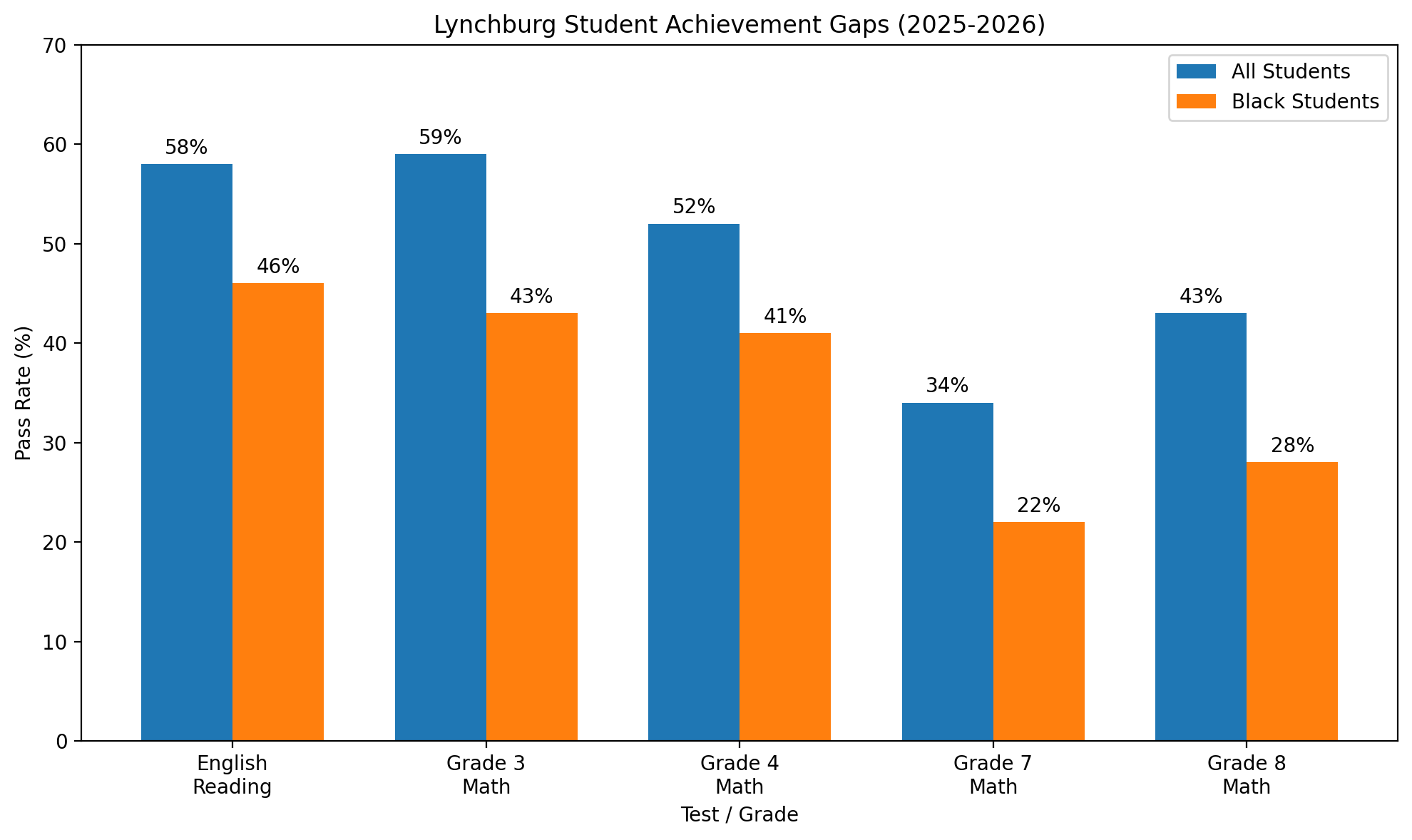
Those figures became part of the Spotlight Insider discussion.
Marshall did not attribute the gaps to one cause. Instead, he pointed to factors that can begin before a child ever enters a classroom: prenatal health, nutrition, childcare, early literacy, family circumstances, income, access to mentors, and exposure to learning before kindergarten. Pasted text
He also pushed back against reducing the issue exclusively to race. Socioeconomic conditions, in his view, are an important part of understanding why some children arrive at school with advantages other children do not have.
That does not remove government from the equation.
Lynchburg City Council has two particularly important connections to public education. Council helps determine local school funding, and it appoints members of the Lynchburg City School Board. The city’s own school board application states that appointments are made at City Council’s discretion.
That makes Marshall’s education emphasis more than rhetorical. Council members can affect the financial and governance environment surrounding the school division, even though they do not directly manage classrooms, curriculum, teachers, or daily school operations.
From Education to a Local Workforce
Marshall’s education argument quickly becomes an economic argument.
One lesson he said he learned from decades at BWXT was that employers cannot wait until a person reaches college to begin talking about careers.
By then, many young people have already decided what they believe they can or cannot become.
Marshall said his own workforce outreach gradually moved from colleges to high schools, then middle schools and even elementary schools. His goal was to expose students earlier to engineering, manufacturing, skilled trades, science, mathematics, and technical careers. Pasted text
That background also helps explain his repeated use of the phrase “grow your own.”
His position is that employers benefit when Lynchburg produces qualified workers locally rather than relying entirely on recruiting people from elsewhere.
The career paths he discussed are not limited to four-year degrees. Marshall highlighted machining, welding, electrical work, HVAC, manufacturing, quality functions, technical certificates, and other skilled occupations. Pasted text
For Marshall, education policy, workforce policy, and economic development are pieces of the same system.
A student who reads well and becomes comfortable with mathematics may later enter a technical program. A technical credential can lead to a stronger-paying job. A stronger-paying job can make housing more attainable. Stable employment can strengthen a household. Stable households can affect neighborhoods and public safety.
That interconnected view is central to how Marshall describes city policy.
Crime: Statistics Versus Experience
The interview began with public safety.
Official Lynchburg Police Department crime data show that reported violent crime declined from 301 incidents in 2024 to 270 in 2025, a 10% decrease. Property crime fell 4% during the same period.
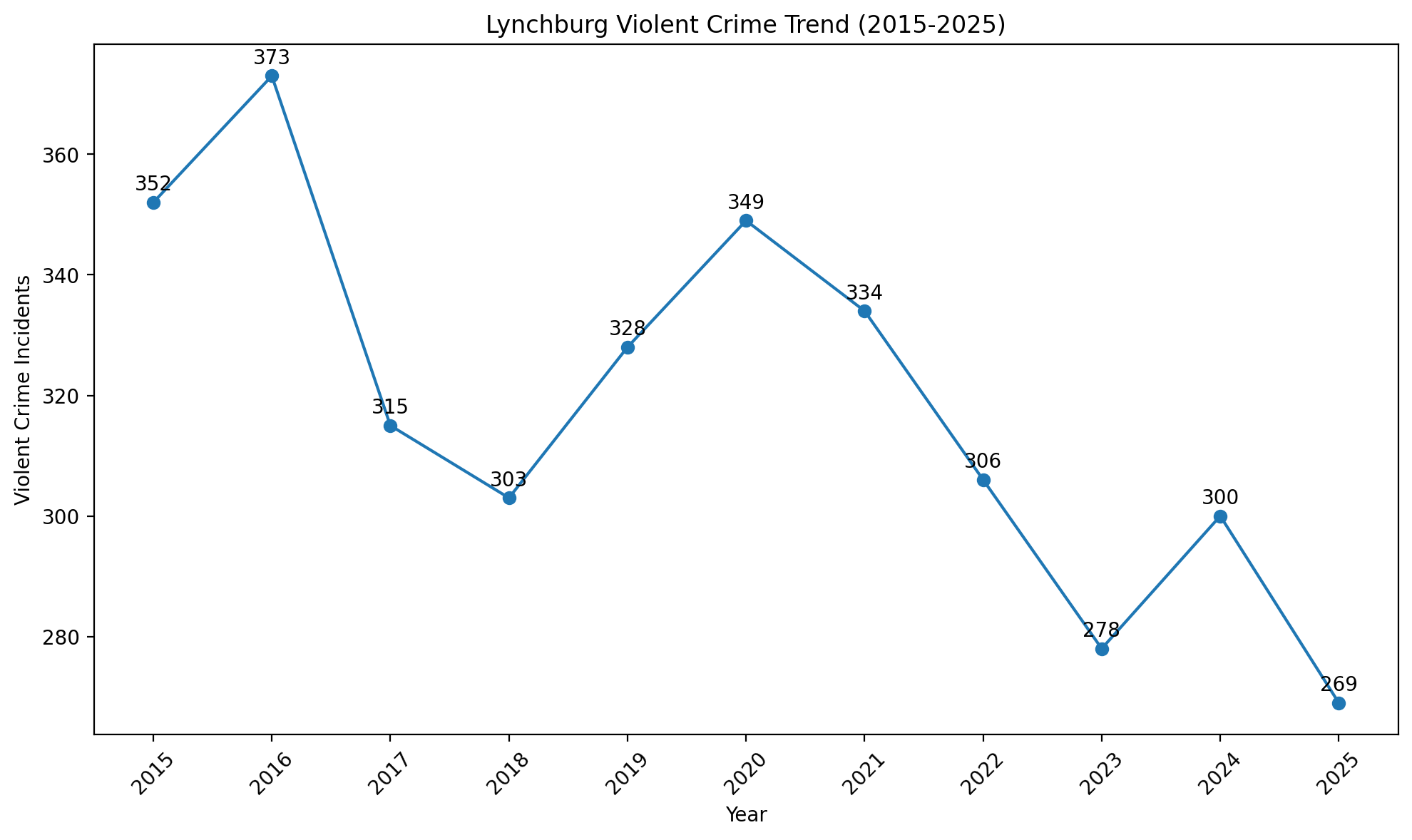
Marshall did not dismiss those numbers.
His point was different: statistics describe a city, but they do not necessarily describe what crime feels like to the person who has just become its victim.
If a family is directly affected by violence, he argued, a citywide decline offers limited comfort.
Marshall’s public-safety approach centers on adequate police staffing, visible officers, stronger relationships between officers and residents, communication and de-escalation training, and more interaction between law enforcement and children before that interaction occurs during a crisis or arrest. Pasted text
He also connected violence prevention to youth programs, sports, community centers, mentors, employment, and constructive activities for teenagers and young adults. Pasted text
That approach treats policing and prevention as parallel rather than competing strategies.
The Human-Resources Candidate
One of the more distinctive parts of Marshall’s interview involved employee morale.
He spent roughly 35 years of his professional career working in or around human-resources functions, and he applied that experience to teachers, police officers, firefighters, and other city employees.
His central claim was straightforward: pay matters, but pay alone does not fix morale.
Employees also want to feel appreciated, listened to, treated fairly, supported by management, and confident that the organization respects the work they perform. Pasted text
Marshall criticized what he sees as empty gestures of appreciation when they are not accompanied by meaningful workplace action.
His prescription begins with listening.
Before proposing a solution, he said, leaders should understand why people are dissatisfied, whether the underlying issue is compensation, management, workload, communication, recognition, culture, staffing, or some combination.
That same human-resources background informs the governing style Marshall says he would bring to City Council.
His preferred rule for conflict is familiar: praise in public, criticize in private.
He described himself as someone who tries to avoid personal attacks, listen before responding, use meeting rules to preserve order, and keep disagreements focused on the issue rather than the individual. Pasted text
That is also consistent with how his campaign was introduced earlier this year. At his January campaign launch, Marshall said his goals included making education the top priority and bringing civility back to City Council meetings.
The Hard Part: Priorities Cost Money
Marshall’s interview became most concrete when the conversation moved from goals to tradeoffs.
Education costs money.
Police and fire departments cost money.
Housing initiatives cost money.
Transportation requires subsidies.
Employees want competitive compensation.
Infrastructure has to be maintained.
And taxpayers rarely ask elected officials to increase their bills.
Marshall acknowledged that tension rather than suggesting every priority can simply be funded.
The current City of Lynchburg budget illustrates the scale of those choices. During development of the FY 2027 budget, Lynchburg City Schools requested $46.6 million in local operating support. The city manager proposed about $44.2 million, while the capital plan proposed $60 million over three years for school facilities and infrastructure.
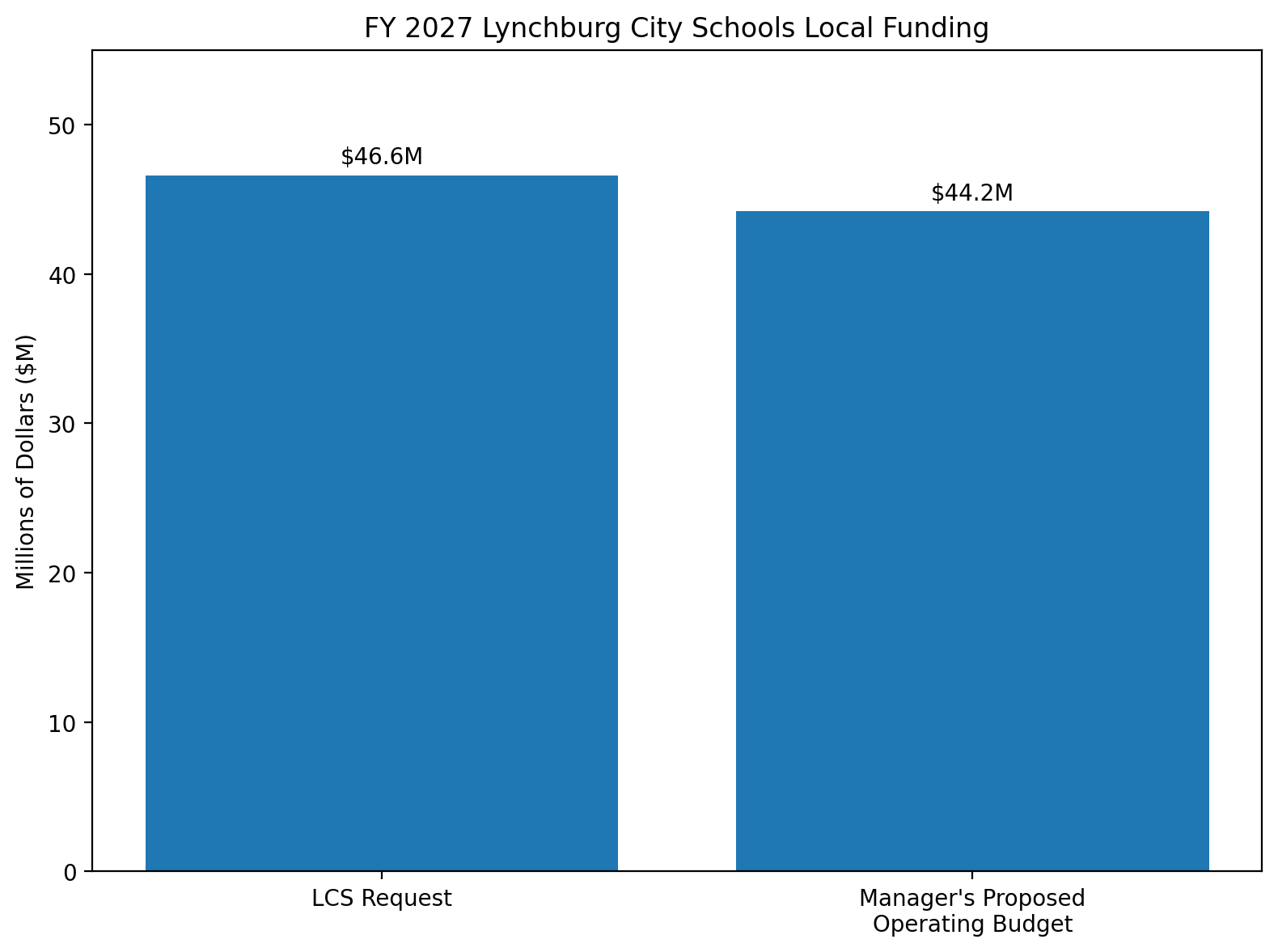
Marshall’s response to these kinds of conflicts is that elected officials have to explain what is financially possible and what is not.
He recalled board situations where the choices were not between a good option and a bad one, but between obligations that were both legitimate.
His stated approach is to look for additional economic activity, tourism, grants, events, partnerships, and outside investment while recognizing that new revenue cannot remove every budget constraint. Pasted text
That is also why his answer on property taxes was more complicated than simply promising lower taxes.
Marshall described property taxes as unpopular but necessary. Police, fire protection, emergency medical response, infrastructure, facilities, and other city services have to be financed somehow. Pasted text
His argument to voters is that the debate should include not only what people pay, but what services those dollars purchase.
Childcare as Economic Infrastructure
One of Marshall’s more specific ideas involves childcare.
He argues that Lynchburg has existing physical capacity that may be underused: churches.
Many church buildings sit largely empty during the workweek while parents struggle to find affordable before-school, after-school, and daytime childcare.
Marshall proposed exploring partnerships in which churches, nonprofits, United Way, employers, and government work together to create additional childcare capacity without requiring the city to construct an entirely new network of facilities. Pasted text
His campaign has increasingly described childcare as an economic-development issue as well as a family issue. During an August listening session with early-childhood providers and community stakeholders, Marshall argued that parents who cannot find reliable care may be unable to work, creating consequences for both families and employers.
The idea is characteristic of Marshall’s broader approach.
Instead of beginning with the assumption that City Hall must directly operate a program, he frequently begins by asking what churches, nonprofits, schools, employers, colleges, and government could do together.
The unanswered policy questions would come later: licensing, staffing, liability, operating costs, subsidies, eligibility, quality standards, and exactly what financial role the city would assume.
Those details would ultimately determine whether a partnership model can move from concept to implementation.
Housing and Transportation
Marshall applied similar thinking to affordable housing.
He said Lynchburg needs more housing that is both safe and genuinely affordable, while warning that rehabilitation efforts can sometimes raise costs enough to displace the people a project was intended to help.
His proposed toolbox includes rehabilitation, nonprofits, churches, accessibility programs, public-private partnerships, existing buildings, and studying approaches that have worked in other cities. Pasted text
Transportation, meanwhile, is something Marshall views as basic economic infrastructure.
A resident who cannot get to work, school, a grocery store, a doctor, or a government office may have opportunities on paper that are inaccessible in practice.
Marshall even said fare-free transit could be worth studying, but he stopped short of presenting it as a free policy choice. The lost fare revenue would have to be replaced.
That distinction matters. Greater Lynchburg Transit Company’s recent budgets show that passenger fares are only one piece of the system’s revenue, with city, state, federal, and other funding also supporting operations.
Sports as Both Youth Policy and Economic Development
Marshall also wants Lynchburg to think more deliberately about sports tourism.
Through his involvement with the Lynchburg Area Youth Sports Initiative, he has worked with local organizations trying to expand access to youth athletics. His campaign biography identifies LAYSi as one of the community efforts of which he is particularly proud.
His City Council argument adds an economic-development component.
Basketball, soccer, tennis, softball, flag football, track and other tournaments bring more than athletes. They bring parents, coaches, hotel stays, restaurant spending, gasoline purchases, shopping, and tax revenue.
Marshall also sees a local equity issue.
Travel sports are expensive. Registration fees, equipment, uniforms, hotels, food, and transportation can put competitive athletics beyond the reach of some families.
His goal is therefore two-sided: attract outside sports activity that generates local spending, while making athletics more accessible to Lynchburg children. Pasted text
AI, Automation and the Next Workforce
Marshall’s workforce experience also shaped one of the interview’s most forward-looking discussions: artificial intelligence.
He does not describe AI simply as a threat to employment.
Marshall expects automation to eliminate or transform some tasks, especially repetitive manual work, while creating other occupations that do not exist today.
His concern centers on how quickly workers can adapt and how much control should be delegated to technology.
He argued for clear guardrails, human oversight, safety mechanisms, and limits on systems that make consequential decisions. He also raised privacy concerns about the growing amount of data collected through connected technology. Pasted text
On potential data-center development, Marshall said policymakers should evaluate water consumption, energy demand, environmental effects, infrastructure requirements, and long-term planning before treating economic development as an automatic benefit. Pasted text
The discussion was forward-looking rather than a response to a specific verified Lynchburg data-center proposal.
What Marshall Means by Servant Leadership
Marshall repeatedly called himself a servant leader during the interview.
His definition is practical rather than ceremonial.
Do not stand at the front of the room and tell someone else to do the difficult work, he said. Stand beside them.
Do not ask employees or volunteers to perform work you would refuse to do.
Focus on completing the task rather than receiving credit for it. Pasted text
That philosophy is consistent with the community biography Marshall has built over several decades.
His service began, he said, with mentoring young men through Big Brothers Big Sisters. Over time, mentoring became board membership, board membership became institutional leadership, and institutional leadership expanded into workforce, education, health, youth sports, nonprofit, and university work.
The question before voters is whether that model of leadership will translate into a seven-member political body where Marshall would control only one vote.
From Collaboration to Governing
That may be the most important distinction in Marshall’s candidacy.
Many of the ideas he described rely on collaboration.
Churches helping with childcare.
Businesses partnering with schools.
Nonprofits addressing housing.
Police building relationships with young people.
Colleges developing the local workforce.
Community organizations expanding sports and mentorship.
Government convening the participants.
It is a model built around the idea that Lynchburg already possesses many of the people, buildings, institutions, and organizations needed to solve problems, but they do not always operate as a coordinated system.
The advantage of that philosophy is that it does not assume City Hall has to become the direct provider of every solution.
The policy challenge is that partnerships still require structure.
Someone has to define responsibilities.
Someone has to determine costs.
Programs need measurable outcomes.
Funding has to survive future budgets.
Participating organizations need accountability.
And a council member still has to decide how to vote when collaboration does not resolve a conflict.
Marshall did not claim during the interview to have a finished ordinance or funding mechanism for every idea he discussed.
Instead, he presented a governing philosophy and a set of priorities.
For voters evaluating him, the next layer of scrutiny is therefore not simply what does Nat Marshall care about?
The interview makes those priorities relatively clear.
The harder questions are: What would he fund first? What would he delay? What would he vote against? How much would each proposal cost? And what numbers should residents examine four years later to determine whether the policies worked?
Those are questions that apply to every person seeking public office.
The Choice Marshall Is Asking Voters to Make
Marshall’s closing argument is built around experience.
He points to four decades in a major local employer, years in human resources, workforce development, nonprofit leadership, education partnerships, university governance, budgets, board procedure, mentoring, and community service.
He also emphasizes temperament.
Marshall describes himself as calm, collaborative, willing to listen, reluctant to make promises he cannot keep, and more interested in moving a project forward than winning an argument. Pasted text
That is the profile he is presenting to Lynchburg voters.
Not simply a retired BWXT executive.
Not simply a nonprofit board member.
Not simply a Democratic candidate.
His pitch is that the different pieces of that résumé have prepared him for a job in which education, public safety, workforce development, taxes, housing, transportation, technology, and community relationships eventually collide at the same table.
On November 3, Lynchburg voters will decide who occupies three of those seats.
Marshall spent months deciding whether he wanted to ask them for one.
Now he has.
And the question that brought him out of retirement has become the question at the center of his campaign:
If not me, then who? If not now, then when?
Early voting for Lynchburg’s November 3 election is underway through October 31. Election information is available through the city’s Registrar’s Office.
See Who Else Has Been In The Spotlight


After 41 years at BWXT and decades of community service, Nat Marshall is running for Lynchburg City Council. His conversation with TeflonJohn explores education, workforce development, public safety, housing, taxes, leadership and the choices facing Lynchburg.