
Fable Forest Speaks Out: The Untold Story Behind the Viral Lynchburg City Council Confrontation with Marty Misjuns
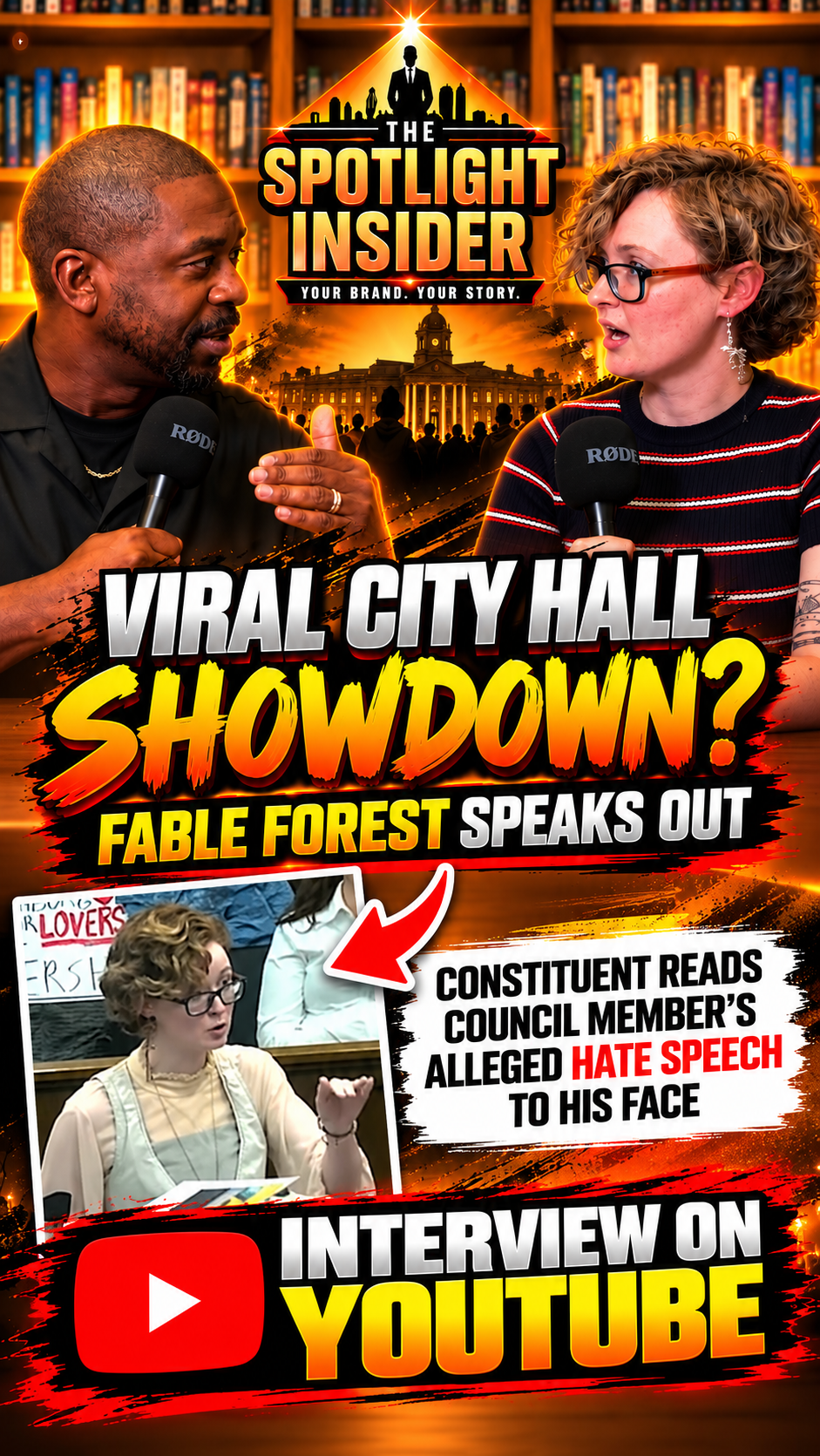
From a three-minute speech that reached audiences nationwide to a deeply personal conversation about discrimination, political accountability, and the power of speaking out, Fable Forest joins TeflonJohn on The Spotlight Insider to explain what led to the confrontation, what happened afterward, and why the controversy extends far beyond one elected official.
By The Spotlight Insider | October 23, 2026
Three Minutes That Sparked a National Conversation
Three minutes. A collection of printed social media posts. One determined Lynchburg resident.
That was all it took for a routine public-comment session at Lynchburg City Hall to become the center of a controversy that would reach far beyond Central Virginia.
On October 13, 2026, Fable Forest stepped before Lynchburg City Council and delivered a pointed criticism of Councilman Marty Misjuns, challenging statements attributed to his public social media accounts and questioning whether an elected official who uses such language can effectively represent an entire community.
The speech was direct, emotional, and, at times, confrontational.
Forest accused Misjuns of promoting rhetoric that they believed was hostile toward LGBTQ+ individuals, Black Americans, Muslims, immigrants, and other communities. Holding printed materials, Forest challenged the councilman and called on fellow council members to address what they characterized as hateful public statements.
Within days, recordings of the exchange spread across social media.
According to Cardinal News, by October 17, the video had accumulated more than one million views on X and more than 550,000 views through an Occupy Democrats YouTube upload, with additional audiences watching across other platforms.
But viral attention rarely tells an entire story.
Who was the individual behind the podium? What motivated the confrontation? How much preparation went into the speech? And what happened after the cameras stopped recording?
In an exclusive, one-on-one interview on The Spotlight Insider, hosted by Johnathan Smith, better known as TeflonJohn, Forest stepped away from the brief viral clip to explain the personal experiences, civic involvement, and concerns about public leadership that motivated the address.
The conversation revealed a story about considerably more than social media controversy.
It was also about belonging, representation, political responsibility, and the sometimes difficult relationship between freedom of expression and the consequences of public speech.
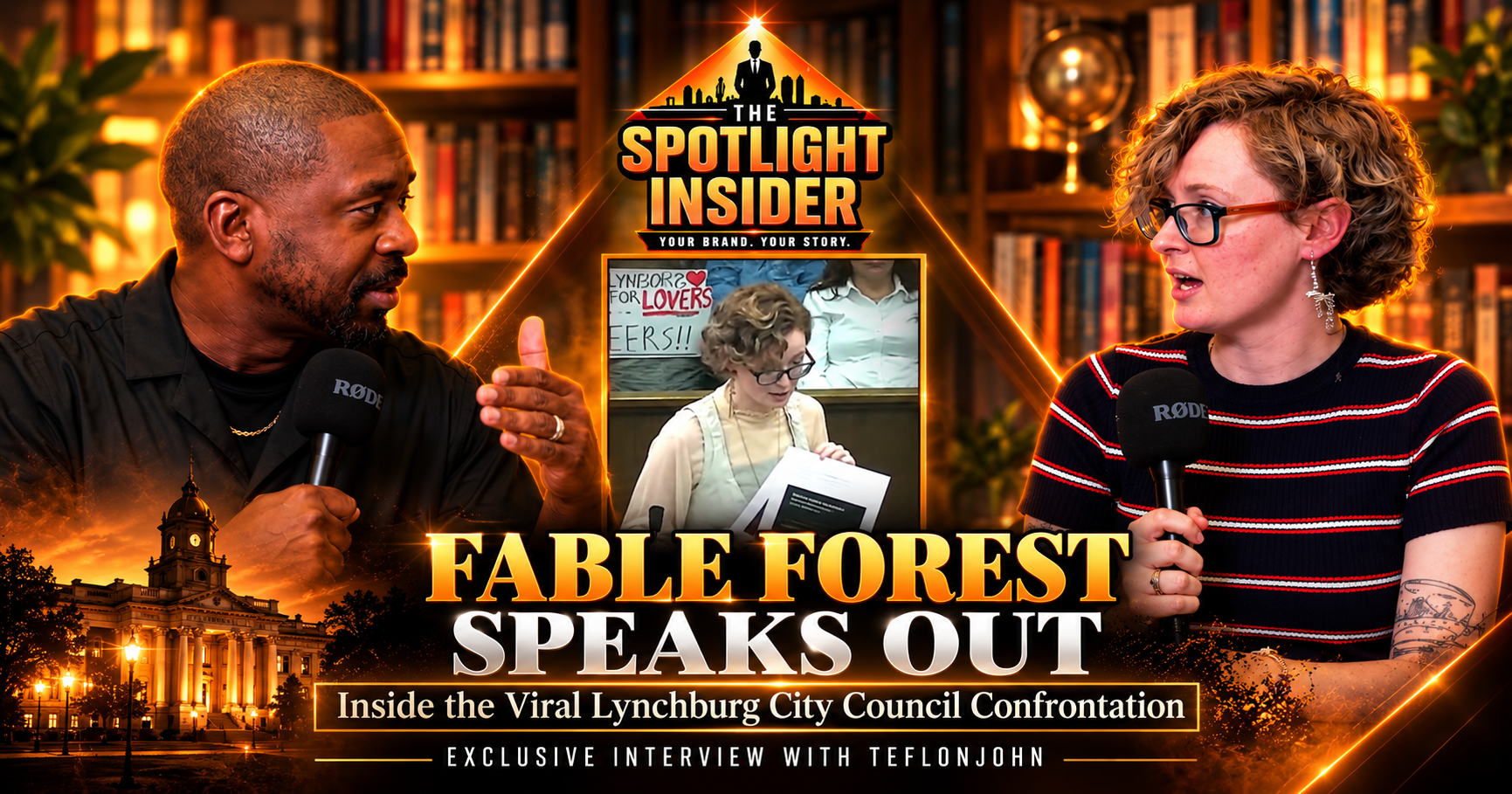
But behind the viral headlines, heated debates, and national attention is a story that goes far beyond a three-minute City Council speech. In an exclusive conversation with TeflonJohn on The Spotlight Insider, Fable Forest opens up about the personal experiences that motivated the confrontation, the controversy surrounding Councilman Marty Misjuns, the reported threats that followed, and the message Forest hopes people will take away. Watch the full interview below, beginning with approximately three minutes of the original viral City Council footage, followed by an in-depth conversation that takes viewers beyond the headlines and into the story behind the moment.
Before the Viral Video: Who Is Fable Forest?
Long before social media audiences began sharing clips of the City Council confrontation, Forest was living a relatively ordinary life in Lynchburg.
Forest told The Spotlight Insider that they moved to the city in 2018 to pursue an education. After graduating, they decided to remain in the area.
The decision was personal.
Forest developed an appreciation for Lynchburg, its surrounding mountains, and the sense of community they had discovered while living there.
Working an office job involving data entry, Forest did not initially view local politics as something that would place them at the center of widespread public attention.
Instead, their interest in government developed gradually.
Forest explained that they began watching City Council meetings to understand how decisions affecting everyday residents were made.
Questions about street maintenance, development, community events, municipal spending, and the responsibilities of city officials led to a deeper curiosity about the workings of local government.
What began as an effort to become better informed eventually developed into a regular habit of following council proceedings.
Over approximately two years, Forest became increasingly familiar with council discussions and began paying more consistent attention during the year leading up to the viral appearance.
But that experience also created frustration.
According to Forest, the council meetings sometimes appeared consumed by disagreements, personal disputes, and political tensions that distracted from the everyday concerns of Lynchburg residents.
For someone who initially tuned in to understand how the city operated, the experience raised another question:
Was the council spending enough time addressing the needs of the people it was elected to serve?
That question would eventually become central to Forest's public criticism.
A Social Media Discovery That Changed Everything
Forest's growing interest in City Council took a different direction after encountering online posts attributed to Councilman Marty Misjuns.
During the interview, Forest described initially becoming concerned about language they considered hostile toward LGBTQ+ individuals.
The issue carried particular significance because Forest identifies as queer and has personal experience with discriminatory language.
But as Forest continued examining the councilman's social media activity, the concerns expanded.
Forest alleged that the posts included disparaging remarks about several groups, including Black women, Muslims, immigrants, LGBTQ+ individuals, and people with opposing political beliefs.
Rather than relying entirely on screenshots circulating online, Forest said they created an X account and attempted to locate original posts.
The stated objective was to determine whether the material was authentic, establish its context, and avoid repeating misleading or fabricated information.
Forest said the research uncovered material posted across multiple years, including some dating from before Misjuns held office.
Several allegations centered on references to anti-gay slurs, racial remarks, religious hostility, and statements Forest believed reinforced harmful stereotypes.
Not every statement discussed during the interview has been independently verified in its original context.
However, independent news reporting has documented several controversial social media exchanges involving Misjuns.
Cardinal News reported on his use of a homophobic slur in one exchange and his participation in another involving the political phrase "Join or Die," a reference to joining the Republican Party.
The disagreement over how such language should be interpreted has become a significant part of the controversy.
Forest considers the statements evidence of conduct inconsistent with the responsibilities of public office.
Misjuns disputes that characterization.
For Forest, however, the issue was not simply whether particular words were offensive.
It was whether residents who belong to the communities referenced in those statements could trust the person making them to represent their interests fairly.
Why the Controversy Became Deeply Personal
One of the most revealing portions of Forest's interview concerned experiences that began long before the October City Council meeting.
Forest described growing up in an environment where being queer was not always accepted.
According to Forest, members of their family reacted negatively after learning about their identity, including threats to send them to a conversion program.
Those experiences shaped how Forest understood the possible consequences of discriminatory rhetoric.
The conversation also turned toward friends and acquaintances who struggled with depression and emotional distress associated with hostility toward LGBTQ+ individuals.
Forest discussed losing people they cared about and described why the subject remains emotionally difficult.
The interview made clear that Forest's concerns about language were connected not only to political differences but also to personal experiences involving fear, rejection, and grief.
Forest believes rhetoric from public officials can have an especially significant impact because those officials possess influence and authority within their communities.
In Forest's view, statements directed at marginalized groups can reinforce the perception that those individuals are unwelcome, particularly when the comments come from someone responsible for representing the public.
The interview also explored the concept of intersectionality, the idea that different forms of discrimination can overlap and affect multiple communities.
Forest argued that addressing discriminatory language cannot be limited to advocating for one group alone.
Concerns affecting LGBTQ+ residents, Black residents, religious minorities, immigrants, and women may be connected, even when the specific circumstances differ.
That broader perspective became an important part of Forest's explanation for the City Council speech.
Three Weeks of Preparation for Three Minutes at the Podium
Despite the spontaneous appearance of the viral moment, Forest said the presentation required substantial preparation.
According to Forest, approximately three weeks were spent gathering material, reviewing statements, examining public information, and developing the message.
The original speech was considerably longer.
Forest explained that earlier drafts were also more aggressive, reflecting the anger experienced while reviewing the material.
But delivering public comments before City Council required a different approach.
With approximately three minutes available, Forest had to decide which examples and arguments deserved priority.
The speech was repeatedly shortened and revised.
Forest said some language was deliberately removed because it was unnecessarily harsh and might distract from the message.
Printed documents were prepared to accompany the remarks, giving the presentation a visual component that later became recognizable in widely circulated video clips.
On October 13, Forest stood before the council, displayed those materials, and challenged Misjuns over statements attributed to his accounts.
The speech criticized his conduct and called for his removal from public office.
Forest also urged other council members to condemn the language and consider what standards of behavior should apply to elected representatives.
The moment became especially contentious because Forest did not limit the criticism to Misjuns alone.
The speech questioned the responsibility of other council members when controversial remarks by a colleague become public.
For Forest, silence from fellow representatives could leave residents uncertain about whether their concerns were being taken seriously.
Misjuns Pushes Back Against the Allegations
The controversy has also generated a public response from Councilman Marty Misjuns.
In reporting published by WSET ABC13 and Cardinal News, Misjuns rejected significant portions of Forest's characterization of his social media activity.
He contended that some statements were missing context and that other allegations were inaccurate or unsupported.
During an interview with WSET, Misjuns questioned the political motivations behind the confrontation, pointing to Forest's position as treasurer of the Central Virginia Young Democrats.
He characterized Forest as a Democratic political operative and argued that the controversy was intended to damage his standing ahead of the November election.
Forest disputes that interpretation.
Although Forest's role with the Central Virginia Young Democrats has been publicly reported, they maintained during The Spotlight Insider interview that the City Council remarks reflected personally held concerns about the conduct of an elected representative.
Forest said the research was based on publicly available material and rejected the suggestion that the speech was simply an attempt to manipulate the upcoming election.
The disagreement illustrates two competing interpretations of the same event.
Forest views the confrontation as an effort to demand accountability for public statements.
Misjuns views the allegations and the resulting attention as politically motivated attacks that misrepresent his positions.
The distinction matters because the underlying controversy includes both questions of public conduct and questions about political context.
Neither the existence of a political affiliation nor the intensity of a criticism, by itself, resolves whether an allegation about a specific statement is accurate.
That requires examining the underlying material, its original context, and the responses of those involved.
Questions for the Rest of City Council
Forest's criticism extended beyond one council member.
During the interview, Forest expressed disappointment that more members of City Council had not publicly rejected the statements being criticized.
Council member Stephanie Reed did issue a public response.
According to WSET, Reed published a statement condemning remarks she considered offensive. She also referenced Misjuns having previously been censured by council.
Forest said that public acknowledgment was significant because it demonstrated a willingness to address the issue rather than avoid it.
The broader question remained whether council members should publicly address controversial speech by fellow representatives and, if so, what form that response should take.
A Controversy Takes a More Serious Turn: Reported Death Threats
As the viral video continued circulating, the controversy took a troubling turn.
Misjuns reported receiving a written death threat following Forest's City Council appearance.
According to Cardinal News, Misjuns said the threat referenced removing him from council chambers and suggested that his movements were being watched.
He stated that he had contacted law enforcement and that the matter was being investigated.
At the time of the report, the Lynchburg Police Department had not independently confirmed those details to the publication.
The reported threat raised a serious question about the distinction between public criticism and intimidation.
Forest's response during The Spotlight Insider interview was unequivocal: threats and violence against Misjuns were unacceptable.
Forest emphasized that criticizing an elected official's statements does not justify threatening that official or members of their family.
The guest explained that personal experiences with fear and discriminatory rhetoric contributed to their understanding of how frightening such situations can be.
Forest said they did not encourage violence and did not want criticism of Misjuns to inspire similar hostility in return.
In a separately reported written statement, Forest also condemned the reported threat and expressed hope that Misjuns would not receive further threats.
The distinction is fundamental to understanding the interview.
Forest continued to defend the decision to challenge the councilman's statements while rejecting threats, intimidation, or physical harm as an acceptable response.
Disagreement with an elected official, no matter how intense, is not permission to threaten that person's safety.
From Lynchburg to a Much Larger Audience
When Forest originally addressed City Council, the immediate audience consisted of the council members, city officials, and members of the public in attendance or watching the meeting.
Within days, that audience expanded dramatically.
The speech was shared through social media accounts, political commentary pages, and news outlets.
Clips were reposted, discussed, praised, criticized, and interpreted by people who had never attended a Lynchburg City Council meeting.
Forest told The Spotlight Insider that the response was surprising.
The widespread attention brought messages from people who supported the speech, including individuals who said they had experienced similar discrimination or felt encouraged to speak more openly about their own concerns.
According to Forest, some messages came from LGBTQ+ individuals who expressed appreciation that someone had publicly challenged statements they found hurtful.
Other responses came from people who valued the broader message about respecting different communities.
Forest also acknowledged that viral attention brought criticism and allegations about personal political motivations.
The experience illustrated how a relatively brief contribution to local government can become part of a much larger national conversation.
Yet there is an important limitation to viral visibility.
A three-minute clip can show what someone said in a particular moment.
It cannot necessarily explain the years of experiences, the preparation, or the beliefs that brought the speaker to the podium.
That distinction was one of the reasons The Spotlight Insider sought to explore Forest's story in a longer interview.
What Forest Wants Lynchburg Residents to Understand
Beyond the controversy, Forest repeatedly returned to the importance of civic participation.
In the interview, Forest encouraged residents to become more familiar with the decisions affecting their communities.
That includes watching public meetings, understanding local procedures, examining proposals, and speaking during public-comment periods when appropriate.
Forest also offered practical advice for anyone considering addressing City Council.
Preparation matters.
Writing down concerns, organizing arguments, stepping away from emotionally charged drafts, and returning to them with a clearer perspective can help residents communicate more effectively.
Forest advised people not to respond to language they consider hateful by adopting the same behavior themselves.
Instead, the message was to direct frustration toward constructive civic engagement.
The remarks reflected a broader belief that participation should not be reserved for elected officials, political professionals, or people with large social media followings.
Ordinary residents have a role in holding government accountable.
Their concerns may involve street repairs, taxes, schools, public safety, discrimination, or how elected officials communicate with the people they represent.
Not every public comment will go viral.
Not every concern will produce immediate action.
But Forest's experience demonstrates how public participation can bring attention to issues that might otherwise remain confined to smaller conversations.
The Bigger Question: What Do We Expect From Public Officials?
At the center of the dispute between Forest and Misjuns is a question that extends beyond Lynchburg.
What standards should the public expect from elected officials when those officials express personal, religious, or political beliefs on social media?
Public officials retain the right to express views, including controversial ones.
Residents likewise have the right to question those views, criticize public conduct, and ask whether an official's statements are compatible with their responsibilities.
The controversy also raises questions about context, political disagreement, and how online statements should be evaluated.
When does provocative political commentary become language that residents reasonably interpret as hostile or discriminatory?
How should elected officials respond when constituents say their public statements have undermined trust?
And what responsibility do fellow representatives have when those disputes reach the council chamber?
Forest and Misjuns offer markedly different answers.
For Forest, public accountability requires acknowledging the possible impact of words on communities that may already feel vulnerable or excluded.
For Misjuns, the dispute has also become an example of what he describes as efforts to mischaracterize and silence conservative viewpoints.
These competing perspectives reflect the larger political tensions surrounding the incident.
But they also underscore why accurate reporting, access to original statements, and opportunities for dialogue matter.
An Open Invitation to Councilman Marty Misjuns
The Spotlight Insider's interview with Fable Forest was intended to provide viewers with the opportunity to hear directly from a person whose public comments had attracted significant attention.
It was not intended to establish every disputed allegation as fact or to suggest that only one perspective deserves to be heard.
The Spotlight Insider also extends an open invitation to Lynchburg City Councilman Marty Misjuns to participate in a separate, one-on-one interview and share his perspective.
That invitation includes an opportunity to discuss the October 13 confrontation, his social media activity, the criticism directed toward him, the reported threat, and any additional matters he believes are relevant.
The objective is to provide space for substantive conversation rather than personal confrontation.
As an independent interview platform, The Spotlight Insider seeks to present stories, experiences, and viewpoints that audiences can consider for themselves.
Providing that opportunity does not constitute an endorsement of a guest's statements or political positions.
Beyond the Viral Moment: A Message About Belonging
Toward the conclusion of the interview, Forest turned away from the controversy itself and focused on people who may feel isolated, unwelcome, or uncertain about whether their voices matter.
The closing message centered on support and human connection.
Forest encouraged those facing difficult circumstances to remember that people willing to listen, help, and offer encouragement exist within their communities.
The guest also emphasized the importance of allowing people to live authentically without requiring perfection as a condition for respect.
It was a quieter conclusion than the forceful speech that had originally attracted so much attention.
And perhaps that contrast is what makes the full conversation significant.
The viral recording captured Forest confronting an elected official.
The longer interview explored what motivated the confrontation, how Forest processed the response, and what they hoped others would learn from the experience.
For some viewers, the speech will remain an example of public accountability.
Others will question its tone, the allegations presented, or the political circumstances surrounding it.
Those disagreements are part of the larger conversation.
What remains clear is that a resident's brief appearance before Lynchburg City Council became a widely discussed example of how local government, social media, individual experiences, and political conflict increasingly intersect.
The attention may eventually move elsewhere.
But the underlying questions about representation, civic participation, freedom of expression, and respectful disagreement will remain relevant long after this particular viral moment fades.
You've seen the confrontation. Now hear the conversation behind it.
Watch the Full Exclusive Interview
🎙️ Fable Forest Speaks Out: The Viral Lynchburg City Council Confrontation with Marty Misjuns
Hosted by Johnathan Smith, aka TeflonJohn, on The Spotlight Insider.
The episode begins with approximately three minutes of the original viral City Council footage, followed by the complete one-on-one interview.
WATCH THE FULL INTERVIEW ON YOUTUBE
Viewers are encouraged to consider the information presented, examine the issues, and engage in respectful discussion.
The Spotlight Insider | Your Brand. Your Story.
An Impryze, LLC Production.
Editorial Disclosure: The Spotlight Insider provides an independent platform for guests to share their experiences and perspectives. Statements and allegations made by guests are their own and do not necessarily reflect the views of The Spotlight Insider, TeflonJohn, or Impryze LLC. Guest appearances do not constitute endorsements. The program does not condone threats, intimidation, harassment, or violence.
Additional Reporting and Sources
Catch Up With Who Has Been In The Spotlight

When TeflonJohn shared his experience surviving a brain tumor, the conversation with congressional candidate Tom Perriello became more than a discussion of healthcare policy. In a wide-ranging interview, Perriello addressed rising costs, the Valley Link transmission project, artificial intelligence, congressional stock trading, and the future of Lynchburg. With Virginia's 5th Congressional District election approaching, the discussion raised an important question: How should voters hold their representatives accountable for the promises they make?