
Tom Perriello Confronts Healthcare, Rising Costs and Congressional Accountability in Virginia's 5th District Race
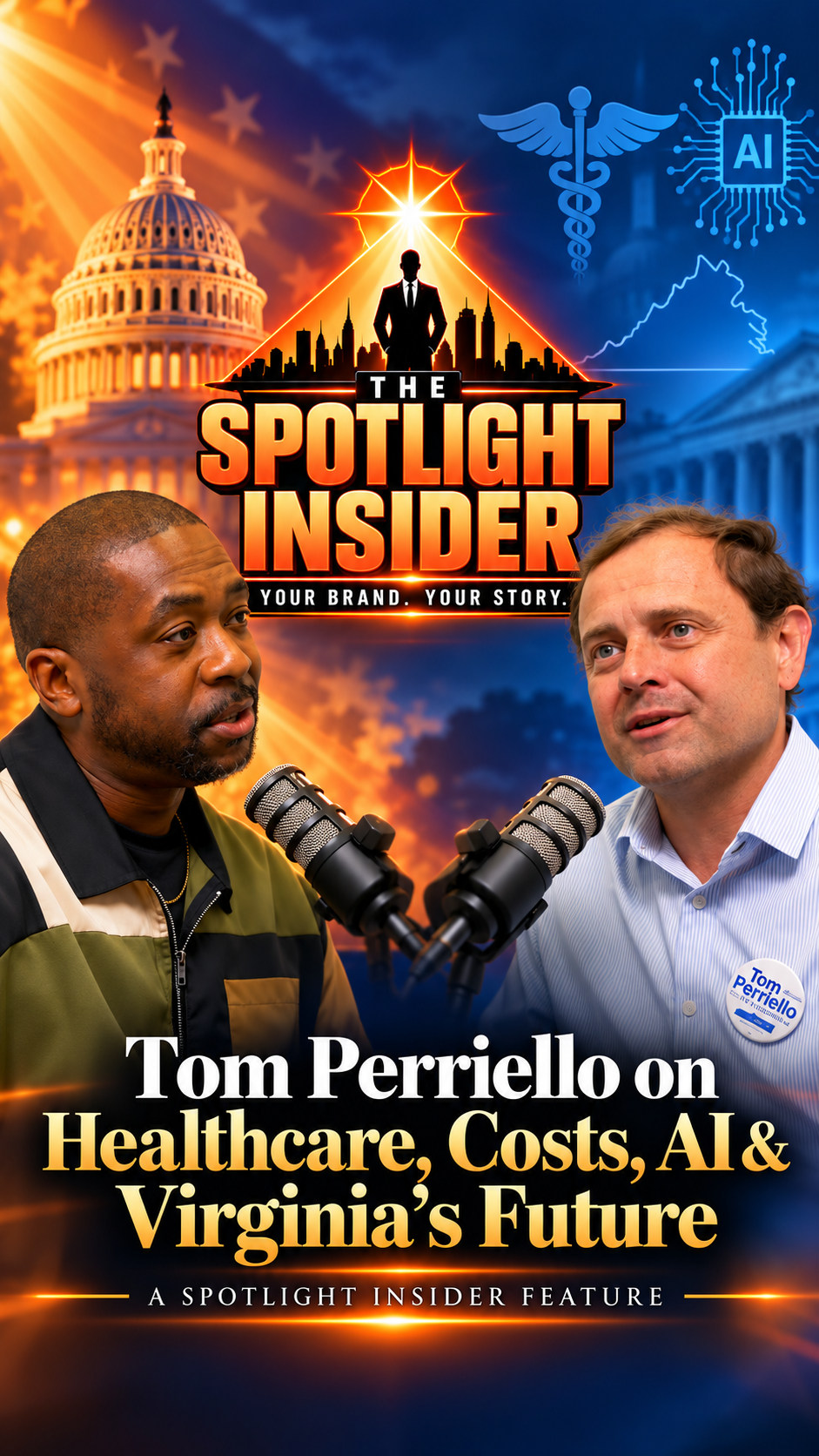
From a personal question about surviving a brain tumor to the controversy surrounding Valley Link, the former congressman outlines his priorities and the promises he believes voters should hold him accountable for.
By The Spotlight Insider | October 23, 2026
A serious medical diagnosis can change a person's life in an instant. But for many Americans, the uncertainty does not end with the diagnosis. There are insurance approvals, hospital bills, prescription costs, follow-up appointments, and the possibility that necessary treatment could become a financial burden.
For Johnathan Smith, professionally known as TeflonJohn, those concerns are more than political talking points. After undergoing surgery to remove a brain tumor in March 2024, followed by radiation and continued medical monitoring, he understands firsthand how quickly healthcare becomes one of life's most urgent priorities.
That experience became one of the defining moments of his conversation with former Congressman Tom Perriello, the Democratic candidate seeking to represent Virginia's 5th Congressional District.
The discussion extended far beyond healthcare. With the November 3 election approaching, Perriello addressed rising household expenses, tariffs, the conflict involving Iran, artificial intelligence, controversial power-line development, public education, and the ethical standards he believes members of Congress should follow.
Together, those issues reveal a central question facing voters across Central and Southside Virginia: What can a member of Congress realistically accomplish to improve everyday life, and how should constituents measure the results?
Watch the Full Interview
During an interview on The Spotlight Insider, Perriello spoke with host Johnathan "TeflonJohn" Smith about his previous service in Congress, the challenges facing Virginia families, and the decisions he would prioritize if elected.
Watch the full Tom Perriello interview on YouTube
Healthcare Becomes Personal
One of the interview's most consequential exchanges began when Smith shared his experience with brain tumor surgery, radiation, recurring MRIs, and ongoing medical appointments.
His question brought healthcare policy into a practical setting: How would Perriello's proposals affect someone who has already experienced a major medical crisis and still requires continuing care?
Perriello responded by advocating universal healthcare coverage, arguing that access to necessary medical treatment should not depend on a person's employer, income, or employment status.
He also acknowledged an important limitation. Although he supports universal coverage as a long-term objective, he does not believe the country could establish such a system within the next two years.
Instead, he identified more immediate priorities, including restoring Medicaid coverage, protecting health insurance assistance for middle-income households, and addressing rising premiums.
That distinction matters. Supporting a sweeping reform is different from identifying legislation that could realistically advance through Congress during a single term.
Perriello also described what he sees as the consequences of reduced healthcare access in surrounding communities. He said Medicaid losses and financial pressures on local clinics can leave patients without regular medical care, increasing reliance on emergency departments.
He cited clinics in Augusta County as an example and argued that when patients lose access to routine treatment, their illnesses do not disappear. Their healthcare needs often become more serious and expensive.
Those claims raise questions extending beyond Medicaid recipients. When patients turn to emergency rooms because preventive care is unavailable, hospitals and other patients can face additional pressures.
The interview highlighted a larger policy dilemma: Should healthcare be treated primarily as an individual financial responsibility, or should government guarantee broader access because the consequences of untreated illness eventually affect entire communities?
For Smith, the issue was not hypothetical. His experience underscored what is at stake when medical decisions and financial circumstances collide.
The Affordability Debate: Gas, Groceries, Housing and Tariffs
Throughout the conversation, Perriello returned to affordability as the foundation of his campaign.
He described families struggling to keep pace with gasoline prices, grocery bills, housing expenses, electricity costs, and healthcare premiums.
His argument is that these pressures cannot be viewed independently. A household already stretched by rising prices may find itself in serious financial trouble after a medical emergency, vehicle repair, or unexpected loss of income.
Perriello also criticized the Trump administration's tariff policies while drawing a distinction between tariffs designed to protect strategic American industries and those he believes increase costs without delivering meaningful economic benefits.
He described the difference as one between "smart tariffs" and "stupid tariffs."
His position was not an outright rejection of tariffs. He said targeted trade measures can help protect manufacturing, strengthen strategic industries, and provide leverage in international negotiations.
His objection centered on the scope, purpose, and economic consequences of current trade policies.
To illustrate the complexity, Perriello discussed American-made products that depend on imported components. Even when a product is assembled domestically, tariffs on its foreign-made parts can increase production costs.
He argued that Congress should exercise greater authority over trade policy rather than allowing major tariff decisions to depend primarily on presidential discretion.
The broader political debate remains contested.
Republican incumbent John McGuire has also made affordability a central concern, but he has emphasized a different explanation for high energy costs. In public remarks reported by VPM, McGuire blamed regulatory obstacles that slow refinery development and argued that expanding fuel production capacity could help reduce prices for families.
The candidates therefore share an emphasis on lowering costs while disagreeing sharply about the policies driving those expenses and the solutions Washington should pursue.
For voters, the distinction is significant. A promise to lower prices is only the beginning. The more difficult questions involve which policies would produce measurable savings, how quickly those savings might appear, and what trade-offs would accompany them.
Iran, War Powers and the Economic Consequences of Conflict
Perriello also connected international security decisions to household finances.
He criticized the administration's handling of the conflict involving Iran and argued that Congress must reclaim its constitutional responsibility over decisions involving military action.
His concerns extended beyond the immediate military consequences.
Perriello warned that instability in the Middle East can disrupt shipping, fertilizer production, fuel supplies, and international trade. Those disruptions can eventually affect American farmers, transportation companies, grocery prices, and consumers.
He specifically discussed the importance of fertilizer supplies and regional infrastructure, emphasizing that military escalation can create economic consequences far beyond the countries directly involved.
The underlying issue is whether Washington has clearly defined the objectives of military action, the limits of presidential authority, and the conditions necessary to bring a conflict to an end.
Perriello argued that Congress should act to restrain unauthorized military operations and establish clearer accountability.
Independent candidate Cooke Harvey has also raised concerns about the Iran conflict, according to VPM's election reporting. Harvey has emphasized government accountability and the need for an alternative to the country's established political divisions.
Their arguments are not identical, but they demonstrate that questions surrounding the war extend beyond a simple Republican-versus-Democrat debate.
Valley Link and the Growing Tension Over Data Centers
For residents of Central Virginia, one of the interview's most locally significant discussions involved the proposed Valley Link transmission line.
The Joshua Falls-to-Yeat project would establish a major 765-kilovolt electrical transmission connection from Campbell County toward Culpeper County, crossing or potentially affecting multiple communities along the way.
The proposed project has generated opposition from residents and local officials concerned about private property, farmland, environmental effects, and the potential use of eminent domain.
Perriello expressed opposition to the project, arguing that rural communities should not bear disproportionate burdens to support electricity demand associated with major corporate developments elsewhere in Virginia.
He questioned whether eminent domain should be used for infrastructure that he believes primarily benefits private business interests.
The controversy reflects a larger tension in Virginia's economic development strategy.
Data centers support digital services, cloud computing, and the expansion of artificial intelligence. They also require substantial electrical infrastructure, land, and investment.
Supporters of new transmission capacity argue that expanding the electrical grid is necessary to maintain reliability and meet growing demand.
PJM, the regional electric grid operator, has identified the Valley Link project as important to regional grid reliability. Project developers have also described the proposed line as a way to strengthen the transmission system and meet future electricity needs.
Opponents question whether those benefits justify the effects on communities along the route.
Perriello's position places him alongside residents who believe property rights, transparency, and local participation deserve greater consideration.
He also argued that data-center operators should pay the full costs associated with their operations rather than shifting expenses onto residential electricity customers.
His comments raise questions about who benefits from technological expansion, who bears its costs, and how much authority communities should have over major infrastructure decisions.
Artificial Intelligence: Opportunity, Risk and Accountability
The conversation about data centers led into a broader examination of artificial intelligence.
Perriello described AI as potentially one of the most powerful technologies humanity has developed.
He compared it to a hammer, a tool capable of building something valuable or causing harm depending on how it is used.
That comparison captured the central concern behind his position: Artificial intelligence has enormous potential, but its consequences depend on the decisions made by developers, companies, governments, and users.
Perriello discussed potential benefits in medicine and other industries while expressing concern about privacy, public safety, democracy, and the effects of emerging technologies on children.
He criticized proposals that he believes could limit the ability of people harmed by AI systems to pursue legal remedies against technology companies.
His position favors stronger oversight and accountability, including bipartisan safeguards.
But regulating AI presents difficult questions of its own.
Lawmakers must consider how to protect consumers without unnecessarily restricting innovation, discouraging investment, or preventing beneficial medical and scientific applications.
For a district containing universities, healthcare institutions, manufacturers, and communities affected by expanding energy infrastructure, those questions are increasingly relevant.
The discussion demonstrated how AI policy connects to local concerns about employment, economic development, electricity costs, and public safety.
Congressional Stock Trading: Should the Rules Apply to Everyone?
Another direct exchange focused on congressional ethics.
Smith asked whether members of Congress should be prohibited from trading individual stocks, particularly when their official responsibilities may expose them to information unavailable to ordinary investors.
Perriello supported a ban.
He also said the restrictions should apply equally to Republicans and Democrats.
During the conversation, he criticized politicians from both parties, including Nancy Pelosi and John McGuire, while arguing that elected officials should be held to higher ethical standards.
The issue involves more than whether an individual trade violates existing law.
It also concerns public confidence in government institutions and the appearance of conflicts between private financial interests and public responsibilities.
Perriello said he would personally refrain from individual-stock trading even if Congress failed to enact a broader prohibition.
He also pledged to reject contributions from lobbyists and corporate political action committees and advocated stronger campaign-finance reforms.
Those promises provide specific standards against which voters could evaluate his conduct if elected.
At the same time, allegations about any individual politician's trading activity require separate examination of financial disclosures, applicable laws, and documented transactions. Criticism during a campaign interview does not establish wrongdoing.
Lynchburg's Schools, Children and Economic Future
The interview also turned toward the future of Lynchburg and the surrounding region.
Smith raised concerns about academic performance and achievement gaps affecting students in Lynchburg City Schools, including disparities involving African-American students.
Perriello emphasized the importance of supporting public schools, strengthening the teaching profession, and investing in early childhood development.
He argued that educational outcomes begin taking shape long before children enter kindergarten.
His proposals included broader access to prekindergarten, greater support for parents of young children, and expanded opportunities for trade-school education and apprenticeships.
He described a broader educational approach that would connect early childhood support, traditional schooling, and career preparation.
The emphasis on early childhood development is particularly relevant to communities confronting childcare shortages and economic barriers that affect working parents.
Perriello also described Lynchburg as a community with substantial potential for growth.
He pointed to the area's universities, healthcare institutions, young professionals, and underused talent as reasons for optimism about the region's future.
But realizing that potential requires more than recognizing it.
Educational investment, workforce preparation, affordable housing, business development, and infrastructure planning all influence whether a growing city can create opportunities that reach residents across different neighborhoods and income levels.
The conversation connected local education concerns to a larger economic question: How can Lynchburg develop its workforce and attract opportunity while ensuring that existing residents share in the benefits?
Three Candidates, Different Visions for Virginia's 5th District
Perriello's campaign is taking place in a district with a long history of supporting Republican candidates.
He previously represented Virginia's 5th Congressional District from 2009 to 2011, after winning election in 2008.
His return to the race places him against Republican incumbent John McGuire and independent Cooke Harvey.
The three candidates offer different approaches to the district's challenges.
Perriello emphasizes affordability, healthcare access, congressional ethics, and limits on presidential authority.
McGuire has emphasized reducing government regulation, addressing fuel costs, national security, and supporting policies aligned with President Trump.
Harvey has presented himself as an alternative for voters frustrated with the established political parties, emphasizing government accountability and a less partisan approach to representation.
Those differences matter in a district that includes Lynchburg, Charlottesville, Danville, and numerous rural communities with distinct economic and political priorities.
Although Perriello discussed what he sees as growing bipartisan support for his campaign, such claims should be evaluated alongside independent polling and election results rather than treated as evidence of an assured outcome.
The outcome will ultimately be decided by voters, not campaign predictions.
The Question That Matters After Election Day
Near the conclusion of the interview, Smith challenged Perriello to identify measurable results voters should expect if he returns to Congress.
The question moved the conversation from campaign proposals to accountability.
Perriello identified ethics, affordability, and constituent service as areas where he believes voters should judge his performance.
He promised to reject lobbyist and corporate PAC contributions, advocate reforms intended to strengthen public trust, fight to lower household expenses, and represent constituents regardless of whether they voted for him.
He also acknowledged that supporting legislation does not guarantee its passage.
That distinction is central to evaluating any congressional candidate.
A member of Congress can introduce legislation, negotiate, vote, provide constituent services, and advocate for policy changes. But accomplishing broader reforms generally requires cooperation from other lawmakers and, often, the president.
Voters therefore have to distinguish between promises a candidate can personally keep and outcomes that depend on the decisions of others.
For Perriello, the test would be whether his actions in office match the priorities he outlined during the campaign.
For McGuire, the test involves his existing voting record and the results of the policies he supports.
For Harvey, the challenge is demonstrating how an independent representative could translate a less partisan approach into meaningful congressional influence.
Each candidate ultimately faces the same fundamental standard: Public service should produce accountability, not simply persuasive campaign messages.
Beyond the Campaign Promises
The most revealing part of the interview was not a prediction about November's election or a criticism of a political opponent.
It was the connection between policy and the everyday experiences of the people those policies are supposed to serve.
Healthcare debates affect patients who need surgery, medication, and long-term monitoring. Energy decisions affect families paying utility bills and landowners concerned about their property. Education policy shapes opportunities for children who may never meet the lawmakers deciding their futures.
Congressional ethics determines whether citizens believe their representatives are acting in the public interest.
Those consequences continue long after the campaign signs disappear.
As Virginia's 5th Congressional District prepares to choose its next representative, the central question is not simply which candidate presents the most convincing argument.
It is which candidate can turn that argument into responsible, measurable public service.
Watch the Complete Conversation
Watch Johnathan "TeflonJohn" Smith's full interview with Tom Perriello for his complete responses on healthcare, affordability, AI, Valley Link, education, national security, and congressional accountability.
Full interview: https://youtu.be/1UkIv-O8oNQ
Explore more interviews: https://www.teflonjohn.com/the-spotlight-insider
The Spotlight Insider provides political interviews and coverage for informational purposes and does not endorse any candidate.
The Spotlight Insider | Your Brand. Your Story.
An Impryze, LLC Production.
Sources, Credits & Editorial Disclosure
Original Reporting: The Spotlight Insider
Interview Conducted By: Johnathan Smith, professionally known as TeflonJohn
Featured Guest: Tom Perriello, Democratic candidate for Virginia's 5th Congressional District
Production: Impryze, LLC
Sources and References
The Spotlight Insider: Original interview with Tom Perriello, October 2026. Watch the full interview.
Virginia Public Media (VPM): Independent reporting on Virginia's 5th Congressional District election, including candidate positions and the affordability debate. VPM
PJM Interconnection: Regional electric grid planning and transmission infrastructure information relevant to the proposed Valley Link project. PJM
Virginia Department of Elections: Official information on candidates, elections, and voting in Virginia. Virginia Elections
Editorial Disclosure
This article is based primarily on an original interview conducted by The Spotlight Insider, supplemented by publicly available information and independent reporting.
Statements concerning public policy, political opponents, campaign promises, and disputed matters are attributed to the individuals making them. Their inclusion does not constitute independent verification or endorsement.
The Spotlight Insider is an independent interview and storytelling platform. Its interviews and political coverage are provided for informational purposes and do not constitute an endorsement of any candidate, political party, or policy position.
The Spotlight Insider | Your Brand. Your Story.
An Impryze, LLC Production.
Catch Up With Who Has Been In The Spotlight


When TeflonJohn shared his experience surviving a brain tumor, the conversation with congressional candidate Tom Perriello became more than a discussion of healthcare policy. In a wide-ranging interview, Perriello addressed rising costs, the Valley Link transmission project, artificial intelligence, congressional stock trading, and the future of Lynchburg. With Virginia's 5th Congressional District election approaching, the discussion raised an important question: How should voters hold their representatives accountable for the promises they make?