
Christina Delzingaro on Lynchburg’s Future: Leadership, Schools, Housing, Transit and the Role of City Council
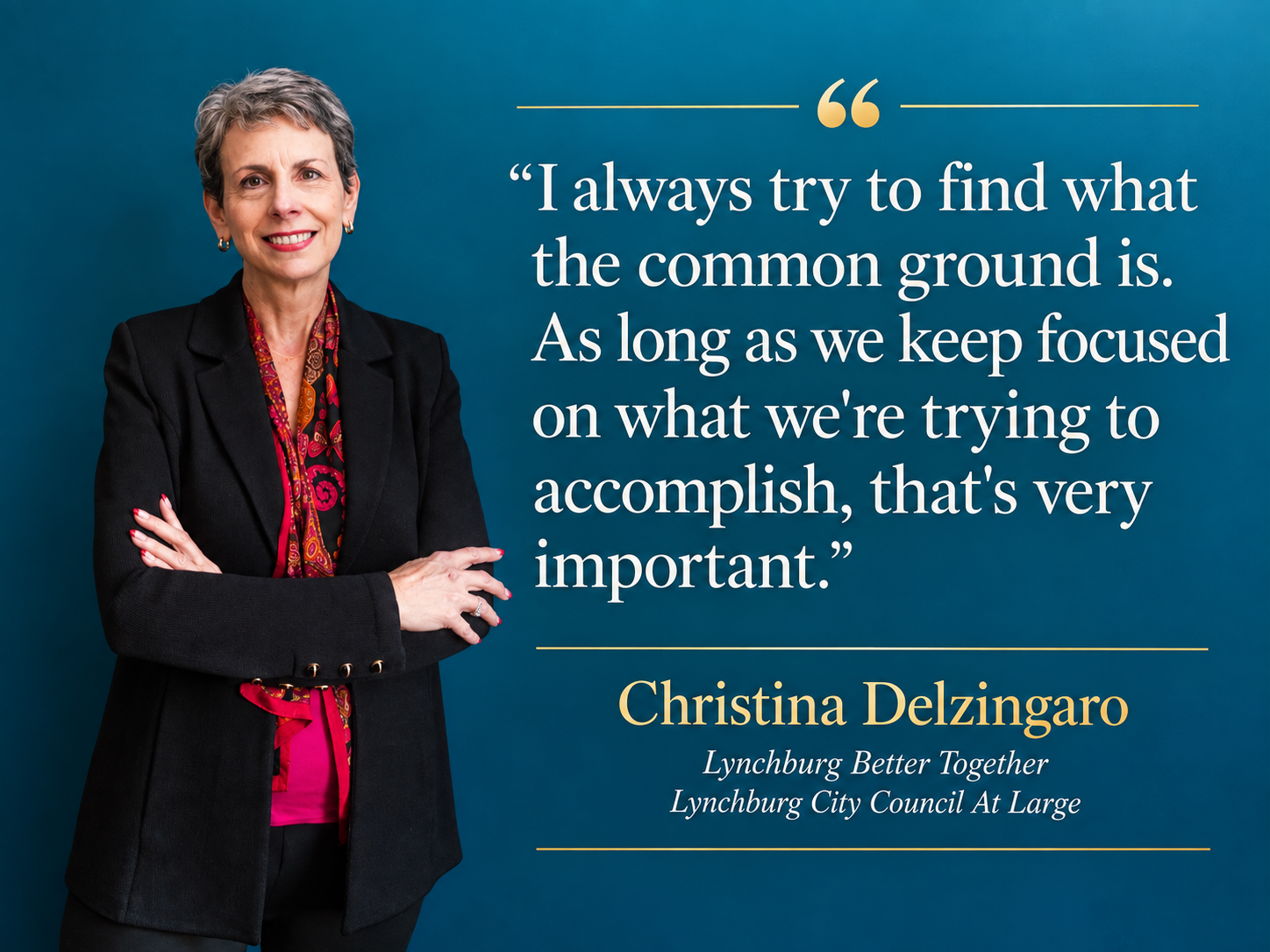
In an in-depth conversation on The Spotlight Insider, Lynchburg City Council candidate Christina Delzingaro discusses why she entered the race, how decades of nonprofit leadership shaped her approach to government, and what she believes Lynchburg should prioritize in the years ahead.
By Johnathan Smith, aka TeflonJohn
The Spotlight Insider | An Impryze, LLC Production
Disclaimer: This interview does not constitute an endorsement of any candidate or political campaign by The Spotlight Insider, TeflonJohn, or Impryze, LLC. The purpose of this conversation is to give the guest an opportunity to share her positions directly with the public. Views expressed by the guest are her own.
⏯️ WATCH THE INTERVIEW 👇🏽
👂🏽LISTEN ON APPLE PODCASTS 👇🏽
From watching City Council to wanting a seat at the table
For Christina Delzingaro, the decision to run for Lynchburg City Council did not begin with a lifelong ambition to hold elected office.
It began, she said, with frustration.
Delzingaro described spending more time attending City Council meetings and watching them from home. She said she became increasingly concerned with arguments, interruptions, prolonged disagreements and meetings that, in her view, sometimes lost focus on budgets, services and solving problems for residents.
At one point, she recalled finding herself talking back to the television, wanting Council to take the vote and move on to the city's business.
Eventually, that frustration became a decision.
She could continue watching and complaining, she said, or she could put herself forward and try to become part of the solution.
The issue of Council decorum has become a significant part of Lynchburg's 2026 election conversation. At a September candidate forum, multiple candidates discussed civility following years of contentious meetings. Delzingaro told the forum that she believes people can "disagree without being disagreeable" and said frustration with the tone of Council was an important factor in her decision to run.
That concern helps explain one of the central themes of Delzingaro's campaign: she believes local government should spend less time on personal conflict and more time making decisions.
Who is Christina Delzingaro?
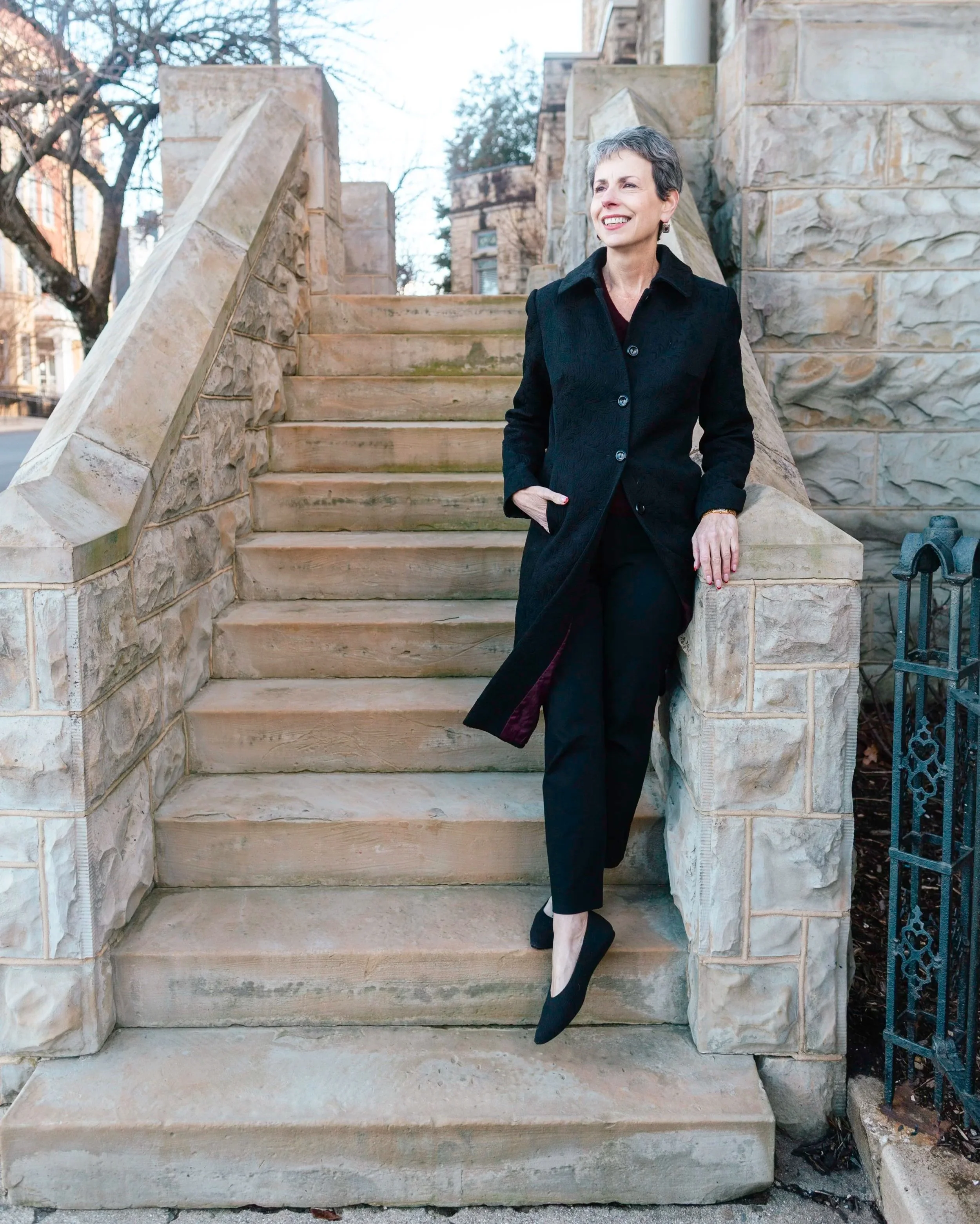
Delzingaro's professional background is centered on health care, nonprofit management and community services rather than elected office.
She currently serves as Chief Executive Officer of Community Access Network, a Lynchburg-based health organization. Community Access Network's official leadership page confirms her role as CEO.
Her campaign biography describes her as a longtime Lynchburg community leader who has worked at the intersection of health care, nonprofit management and community engagement. It says she oversees an organization with a roughly $16 million budget and 75 employees.
During our conversation, Delzingaro traced that experience through approximately three decades of nonprofit and public-service work.
She discussed leading the Free Clinic of Central Virginia, earlier work in social services, board leadership, financial oversight and the development of Community Access Network.
What she repeatedly returned to was not simply the organizations themselves, but what those experiences taught her about leadership.
She identified three characteristics that she believes define her approach:
Deep listening. Curiosity. Tenacity.
When asked which might be her "superpower," she chose tenacity.
Her explanation was straightforward. When she is told something cannot be accomplished, her instinct is often to investigate further and determine whether another path exists.
A problem-solving approach to leadership
Delzingaro often described herself less as a politician and more as a problem solver.
One example she discussed was the development of Community Access Network.
She said she saw gaps in access to health care and did not want simply to acknowledge that a problem existed. She wanted to understand why it existed, identify the people and organizations needed to address it, and begin developing a solution.
That mindset is important to understanding how she describes her approach to City Council.
She does not present governing as one person arriving with all the answers.
Instead, her preferred model involves:
identifying the actual problem,
gathering reliable information,
listening to people with expertise,
understanding available resources,
weighing competing options,
making a decision,
and evaluating whether that decision produced the intended result.
That approach also shapes how she talks about disagreement.
The "velvet hammer"
One of the most memorable phrases from the interview was Delzingaro's description of her leadership style as a "velvet hammer."
For her, kindness and accountability are not opposites.
She said leaders should be able to tell someone when performance is inadequate, when a proposal is flawed, or when the organization needs to change direction without turning the disagreement into a personal attack.
Her preferred approach to governing is similar.
State the position.
Explain the desired outcome.
Present the evidence.
Allow others to make their case.
Determine where the votes are.
Then make the decision and move forward.
She made clear that she does not expect every City Council vote to be unanimous.
The larger point is that disagreement does not have to prevent governing.
Understanding what City Council actually does
A significant part of our conversation centered on the distinction between governance and management.
Delzingaro said she does not believe council members should attempt to personally operate city departments or substitute their judgment for trained professionals in highly technical areas.
She used the example of a water-treatment facility. A council member does not need to know how to physically operate the plant. The elected official needs qualified staff to explain the issue, the available options, the financial consequences and the risks.
The council-manager structure of Lynchburg government reflects that distinction. Lynchburg has a seven-member Council, with four ward representatives and three members elected at-large. Council establishes policy and hires a professional city manager to oversee the delivery of services. Lynchburg VA Official Website
Delzingaro said she sees the elected body's role as establishing direction, approving budgets and policy, asking difficult questions and holding the administration accountable for results.
That philosophy becomes especially important when discussing schools.
Education and Lynchburg's student outcomes
Looking honestly at the numbers
Education was one of the largest portions of our interview.
Delzingaro said she believes student performance requires urgent attention and that Lynchburg cannot simply become accustomed to disappointing academic results.
The current Virginia School Quality Profiles provide important context.
For 2025-26 English Reading, Lynchburg City Public Schools reported a 58% pass rate among all students and a 46% pass rate among Black students.
The gaps become even more pronounced in some grade-level results. In Grade 7 English Reading, 52% of all students passed, compared with 37% of Black students and 78% of White students.
Those numbers became a starting point for a larger conversation rather than the end of one.
Delzingaro questioned whether the achievement gap should be viewed solely through race or whether poverty and economic conditions are also playing a substantial role.
The same state data shows an economic disparity. In 2025-26 English Reading, 44% of economically disadvantaged students passed, compared with 67% of students who were not economically disadvantaged.
That does not prove that poverty is the single explanation for student performance.
Delzingaro did not claim that it was.
Instead, she argued that education has to be considered alongside the circumstances affecting children outside the classroom.
Those may include family stress, food insecurity, unstable housing, health concerns, transportation, parental work schedules, attendance, staffing levels and other factors.
Poverty and education
Economic hardship is not a minor issue in Lynchburg.
The U.S. Census Bureau estimates that 18.6% of Lynchburg residents live below the poverty line, while median household income for 2020-24 was $57,947.
Delzingaro's broader argument is that improving student performance may require thinking beyond what happens during the school day.
If a child is dealing with unstable housing, limited food access, health problems or significant stress at home, those conditions can intersect with learning.
For Delzingaro, that makes education part of a larger community conversation involving schools, families, nonprofits, employers, health providers and city government.
She also acknowledged that she does not know every reason student performance has declined.
That uncertainty, she said, is precisely why officials should be willing to investigate rather than pretend that one explanation solves everything.
Should Lynchburg spend more on schools?
Delzingaro said she would not support reducing school funding simply because outcomes are disappointing.
Her argument is that lower performance may be a reason to investigate how resources are being used, but it does not necessarily follow that the solution is to remove resources.
For FY 2027, Lynchburg City Schools requested $46.6 million in local operating funding. The city manager's proposed budget included $44,206,870.
Delzingaro said she does not support giving the school system an unlimited blank check.
She does, however, believe Lynchburg needs to take seriously issues such as teacher compensation, staffing, classroom support and working conditions.
That creates an important distinction.
City Council does not run the schools.
The School Board and school administration are responsible for educational operations.
Council's primary leverage is through funding, broader city policy and partnerships.
Delzingaro's challenge, if elected, would be balancing support for education with the responsibility to ask what taxpayers are receiving for additional investment.
Jobs, poverty and economic mobility
Delzingaro repeatedly returned to a larger issue beneath several policy discussions: economic stability.
She connected wages and employment to education, housing, health, crime, transportation and family stress.
During the interview, she referenced approximately $22 per hour as a living-wage benchmark in Lynchburg.
MIT's 2026 Living Wage Calculator estimates that a single Lynchburg city adult with no children would need approximately $21.79 per hour to cover basic needs. The required wage rises substantially for households with children.
Delzingaro said economic development should therefore be measured by more than the number of new businesses that open.
She wants the city to consider:
wage levels,
benefits,
paid leave,
career advancement,
workforce development,
and whether residents can realistically support themselves through the jobs being created.
Her four-year vision includes attracting new employers while also helping existing Lynchburg businesses expand.
Free city buses: one of Delzingaro's clearest proposals

When asked to identify an issue she feels particularly passionate about, Delzingaro chose fare-free public transportation.
Her reasoning connects transportation to opportunity.
If a resident cannot get to work reliably, transportation becomes an employment issue.
If someone cannot reach a doctor's appointment, transportation becomes a health issue.
If a student cannot reach a training program, transportation becomes an education issue.
And if residents are limited to shopping or services within walking distance, transportation can also become a household-cost issue.
GLTC currently charges $2 for a standard one-way ride, $4 for a day pass and $50 for a 31-day pass.
Eliminating fares would therefore require a financial plan.
The city and GLTC would need to determine how much fare revenue would be lost, how it would be replaced, whether ridership would increase and whether increased ridership would affect operating costs.
Delzingaro's argument is that the analysis should also consider benefits that may occur outside the transit system.
If better transportation helps someone keep a job, attend medical appointments or complete job training, she believes those effects should be part of the calculation.
Her campaign has also participated in listening sessions with GLTC leadership focused on transportation's relationship to employment, health care, schools and economic activity.
Housing, renters and homeownership
Housing is another area where Delzingaro sees multiple issues converging.
She discussed both rental housing and homeownership.
On the ownership side, Delzingaro views owning a home as an important way families can build long-term and generational wealth.
She supports examining additional pathways into homeownership, particularly for first-time buyers and workers such as teachers, nurses, firefighters, police officers and other people serving the community.
For renters, her concern is different.
She said residents have told her about maintenance problems and situations in which tenants may be reluctant to complain because they fear losing housing they cannot easily replace.
The city's own 2025-29 Consolidated Plan identifies a substantial need for affordable housing, notes that Lynchburg's housing stock is aging and lists rehabilitation as a continuing priority.
Lynchburg also operates a proactive rental inspection program in designated areas. The city says the program is intended to improve housing safety and recognizes that concerns such as landlord retaliation may discourage some tenants from reporting problems themselves.
Delzingaro said she wants the city to continue examining whether enforcement systems provide sufficient protection while also working constructively with responsible property owners.
Homelessness requires more than one solution
Delzingaro described homelessness as one of the city's most difficult and emotional challenges.
Her approach is deliberately broad.
She does not see homelessness simply as a lack of shelter.
She pointed to possible connections involving:
mental health,
substance-use disorders,
affordable housing,
employment,
behavioral-health services,
and long-term economic instability.
She also emphasized that Lynchburg already has nonprofit and community organizations working in this space.
Her question is whether those organizations and city government have the resources, coordination and partnerships necessary to produce better results.
The city currently administers federal housing resources including the Community Development Block Grant and HOME programs, and its five-year planning addresses affordable housing and homelessness-related needs.
Delzingaro's approach is largely collaborative. She wants local government, nonprofit providers, state and federal resources, health systems and housing organizations working from a more coordinated strategy.
Public safety, community policing and technology
Delzingaro's public-safety discussion reflected a similar balancing approach.
She expressed support for law enforcement having tools that help officers protect residents.
At the same time, she said government should not treat privacy concerns as irrelevant simply because a technology may be useful.
That debate has become especially relevant in Lynchburg because of the city's use of Flock automated license plate recognition cameras.
On August 19, 2026, Lynchburg Police temporarily paused its 15 fixed Flock ALPR cameras while the department and city conduct an independent third-party review of policy, procedures, training and operations. LPD said the decision was not prompted by identified misuse and said the technology had helped with stolen vehicles, missing people, violent offenders and criminal investigations.
Delzingaro said she believes the city should understand:
what data is collected,
who can access it,
how long it is retained,
how it is shared,
what safeguards exist,
and whether the technology is producing measurable results.
Her position was not an automatic rejection or automatic endorsement.
She described it as a question requiring evidence and public trust.
Lynchburg's crime data also adds context. LPD reports that violent crime declined from 301 incidents in 2024 to 270 in 2025, a 10% decrease. Homicides decreased from nine to eight, although the 2025 homicide total remained above the five-year average reported by the department.
Delzingaro also supports strengthening community policing, saying stronger relationships between officers and neighborhoods can improve trust, communication and prevention.
Financial literacy and access to opportunity
Financial literacy came up several times during the interview.
Delzingaro argued that practical financial education can benefit people across income levels.
Her interest includes helping residents better understand saving, credit, budgeting and the financial decisions involved in homeownership.
She also sees financial literacy as something that could be reinforced through schools, after-school programs, nonprofits and partnerships with financial institutions.
For Delzingaro, however, financial education is not a substitute for adequate income.
Teaching someone to budget does not change the fact that housing, transportation, food and health costs may exceed what a low-paying job can reasonably support.
Her approach combines education with the broader pursuit of stronger wages and economic opportunity.
Crime, second chances and employment
The relationship between jobs and public safety also surfaced in the discussion about people returning from jail or prison.
Delzingaro said employment can be important to successful reentry and reducing the conditions that may contribute to repeat offending.
She supports working with employers willing to provide opportunities to qualified returning citizens.
At the same time, her comments did not remove individual responsibility from the equation.
The broader idea is that accountability and opportunity can exist simultaneously.
People can be held responsible for unlawful behavior while communities also consider whether stable employment, housing and support make successful reentry more likely.
Transparency should explain more than the final vote
Delzingaro's definition of government transparency extends beyond whether meetings are technically open to the public.
She said residents should be able to understand:
what decision is being made,
what options were considered,
what the financial implications are,
why Council reached its conclusion,
and how the result affects the community.
For her, transparency is connected to communication.
A vote alone tells the public what happened.
Good government, she argues, should also explain why.
Downtown matters, but so do the neighborhoods
Delzingaro supports downtown development and sees a healthy downtown as an important part of Lynchburg's economy and identity.
At the same time, she said economic development cannot stop downtown.
She wants broader implementation of city planning across neighborhoods, including attention to housing, transportation, infrastructure and quality of life.
That reflects a recurring theme throughout the interview.
She tends to connect individual policy areas rather than discuss them as isolated subjects.
Housing affects health.
Transit affects jobs.
Schools affect economic development.
Wages affect housing stability.
Neighborhood stability affects public safety.
Her approach is built around those relationships.
AI data centers: revenue versus long-term costs
Another forward-looking part of the interview focused on AI data centers.
Delzingaro said she would approach major data-center development cautiously.
She acknowledged the potential benefits, including tax revenue and economic investment, but said city officials would need to understand costs that may be less obvious at first.
Those questions could include electricity demand, water use, land use, infrastructure, noise, neighborhood effects and the number of permanent jobs created.
Lynchburg has already been examining how data centers should be regulated. City planning materials from 2026 proposed requiring conditional-use permits for data centers in specified industrial and institutional zoning districts and establishing specific development standards.
Delzingaro's position in our conversation was essentially one of due diligence.
A large investment should be evaluated on its full long-term impact, not simply the initial revenue projection.
Lynchburg Better Together and individual independence
Delzingaro is campaigning alongside Dave Henderson and Nat Marshall through Lynchburg Better Together, which supports the three Democratic candidates seeking Lynchburg's at-large City Council seats. The organization says it works in partnership with Rural GroundGame, a Virginia political action committee.
During the interview, Delzingaro emphasized that campaigning together does not mean the candidates are identical.
They may share broad priorities but bring different backgrounds and approaches.
She also stressed that voters are not required to support all three candidates.
Lynchburg's three at-large council seats are elected citywide, while its remaining four council members represent individual wards.
Delzingaro said that if elected, her responsibility would be to the entire city, including residents who disagree with her politically or did not vote for her.
Being a woman in leadership
Delzingaro also spoke candidly about spending much of her career in environments where she sometimes felt her authority or expertise was questioned.
She said those experiences taught her how to remain firm without automatically escalating conflict.
She emphasized preparation, evidence and persistence.
Her philosophy is not that disagreement should disappear.
It is that disagreement should not prevent people from doing their jobs.
That idea connects directly back to her criticism of the current City Council environment and her "velvet hammer" approach.
Failure, accountability and admitting when you are wrong
One of the more personal parts of the interview dealt with failure.
Delzingaro said leaders have to be comfortable acknowledging that they do not know everything.
She talked about distinguishing between:
what you know,
what you do not know,
and what you may not yet realize you do not know.
She also said innovation carries the possibility of failure.
In her view, trying something new and discovering it does not work is different from refusing to acknowledge that you were wrong.
She said leadership requires both experimentation and accountability.
It also requires people around you who are willing to tell you when you are making a mistake.
That self-awareness, she acknowledged, is something every leader has to continue working on.
Listening directly to residents
Delzingaro said campaigning has reinforced her belief in direct conversations with residents.
She described knocking on thousands of doors and listening to people discuss problems that may not always appear in a city report or public meeting.
Those conversations, she said, expose candidates to differences in experience across neighborhoods.
Her campaign and the other Lynchburg Better Together candidates have also participated in listening sessions involving teachers, renters, business owners, transit leaders and young people.
Delzingaro said listening does not mean promising everyone the answer they want.
It means understanding what residents are experiencing before making decisions that affect them.
What would success look like after four years?
Toward the end of our conversation, I asked Delzingaro to move beyond general statements about making Lynchburg better.
What should residents actually be able to see after four years?
Her answer focused on several priorities.
A budget residents can understand
She wants the city's financial decision-making to be easier for residents to follow, including clearer explanations of priorities and tradeoffs.
Progress toward fare-free public transportation
Free buses remain one of her clearest policy interests, tied to access to jobs, health care, school and economic opportunity.
Stronger economic development
She wants to see new businesses entering Lynchburg, existing businesses expanding and more residents working in jobs that provide livable wages and benefits.
Improved educational outcomes
She said she would expect Lynchburg schools to be in a stronger position four years from now, while acknowledging that SOL scores are only one measurement of student success.
Each of those goals involves a different degree of City Council authority.
Council can directly adopt city budgets and policies.
It can influence transit funding and economic-development strategy.
It provides local funding to schools but does not directly control classroom operations.
For Delzingaro, the governing challenge would be converting those broad priorities into specific decisions, partnerships and measurable results.
The central theme of Christina Delzingaro's campaign
After discussing City Council, education, poverty, housing, transportation, policing, economic development, technology and government transparency, one theme consistently emerged from Delzingaro's responses:
She believes city government should function as a problem-solving institution.
She points to decades of experience managing organizations, navigating complicated funding, bringing people together and working through disagreements as preparation for public office.
Her policy ideas also raise legitimate implementation questions.
How much would fare-free transit cost?
How should additional school investment be measured?
What role should government play in expanding housing?
Which economic-development tools produce the strongest return?
How should public safety technology balance effectiveness and privacy?
Those are not reasons to avoid the proposals.
They are the kinds of questions candidates seeking responsibility for public resources should be expected to answer.
That is also the purpose of The Spotlight Insider Candidate Series.
The goal is not to tell Lynchburg residents which candidate deserves their vote.
It is to ask substantive questions, give candidates room to explain their thinking and provide voters with more information before they make their own decision.
Christina Delzingaro's conversation provided an extended look at her professional background, leadership philosophy, policy priorities and the kind of City Council member she says she would seek to become.
Now the decision belongs where it should.
With the voters.
Watch the Full Interview
🎙️ Christina Delzingaro Faces Lynchburg's Big Questions
Hosted by Johnathan Smith, aka TeflonJohn
The Spotlight Insider
An Impryze, LLC Production
Your Brand. Your Story. Your Spotlight.
See Who’s Been Shinning Near You
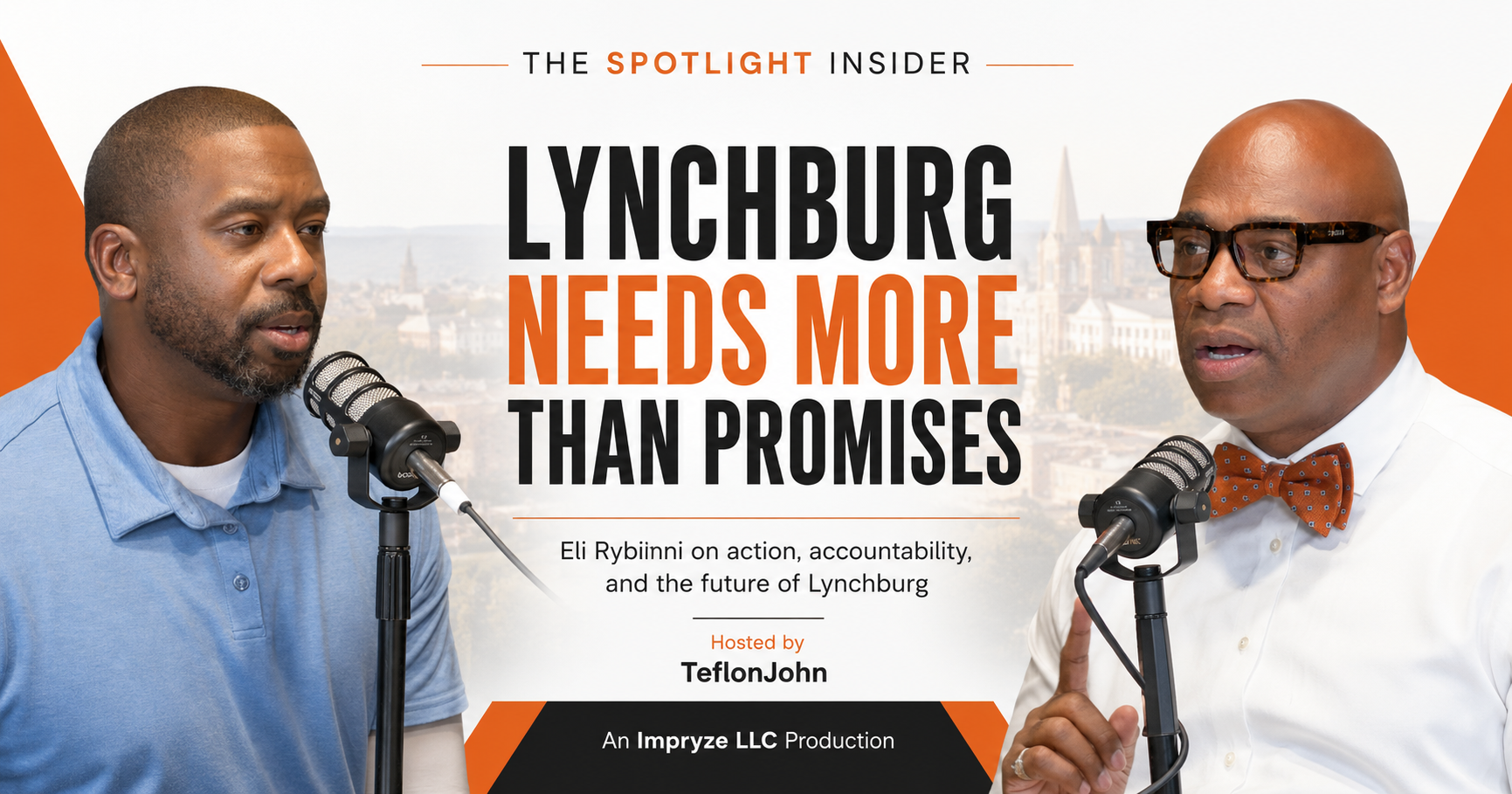



Christina Delzingaro sits down with Johnathan Smith, aka TeflonJohn, on The Spotlight Insider to discuss why she is running for Lynchburg City Council and her views on schools, housing, transportation, jobs, public safety and local government.