
Eli Rybinni Makes His Case for Lynchburg City Council, With a Focus on Crime, Schools and Opportunity
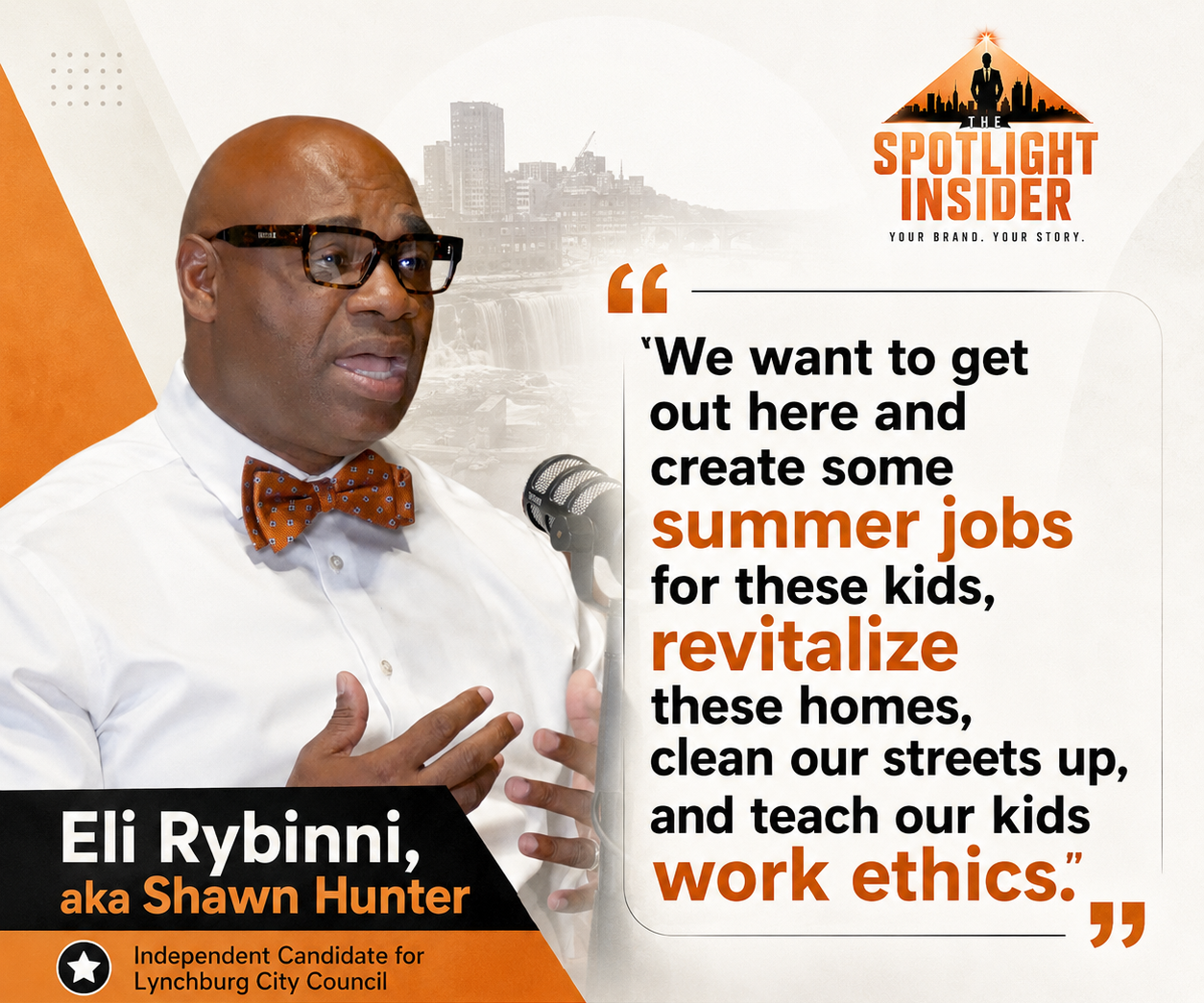
Click Play ⏯️ To Watch The Full Interview
⚠️Disclaimer: This article and accompanying interview are presented for informational and journalistic purposes. The appearance of Eli Rybinni, aka Shawn Hunter, on The Spotlight Insider does not constitute an endorsement by TeflonJohn, The Spotlight Insider, or Impryze LLC of his candidacy, campaign, or political positions. Views expressed by the guest are his own. The purpose of this coverage is to give the public an opportunity to hear directly from the candidate, examine his ideas, and form their own conclusions.
Independent candidate Eli Rybinni, also known as Shawn Hunter, is asking Lynchburg voters to consider a different kind of City Council campaign, one centered on prevention, neighborhood investment and what he describes as measurable action.
In a wide-ranging interview on The Spotlight Insider, hosted by Johnathan Smith, aka TeflonJohn, Rybinni laid out his priorities for Lynchburg while also explaining why he believes the city needs stronger intervention in areas such as crime, education, housing, homelessness and youth development.
The interview, produced by Impryze LLC, covered both his policy ideas and the larger question behind his campaign: whether Lynchburg is doing enough to address problems before they become crises.
From Community Activism to a Run for Office
Rybinni said his decision to run for an at-large City Council seat grew out of his community work and what he viewed as persistent problems in parts of Lynchburg.
He pointed to crime, homelessness, substance abuse, unemployment and neglected neighborhoods as issues he believes require more aggressive action.
Rather than continuing to work only from the community side, he said he wants a seat at the table where funding, policy and citywide priorities are decided.
His argument is straightforward: community organizations can identify problems and help residents, but elected office provides greater access to grants, partnerships and public resources.
An Independent Campaign Built Around Accountability
Rybinni is running as an Independent, a distinction he emphasized throughout the interview.
He expressed skepticism about the influence of political parties, donors and powerful community figures on candidates and elected officials.
His position is that independence gives him more freedom to answer directly to residents rather than party leadership or financial supporters.
That claim also creates a higher standard for his campaign.
If a candidate campaigns on independence, voters are likely to ask what that independence looks like once compromise, budgets and governing coalitions become necessary.
Rybinni said he would focus on building working relationships with other council members and avoid turning disagreement into constant conflict.
Education Emerges as a Top Priority
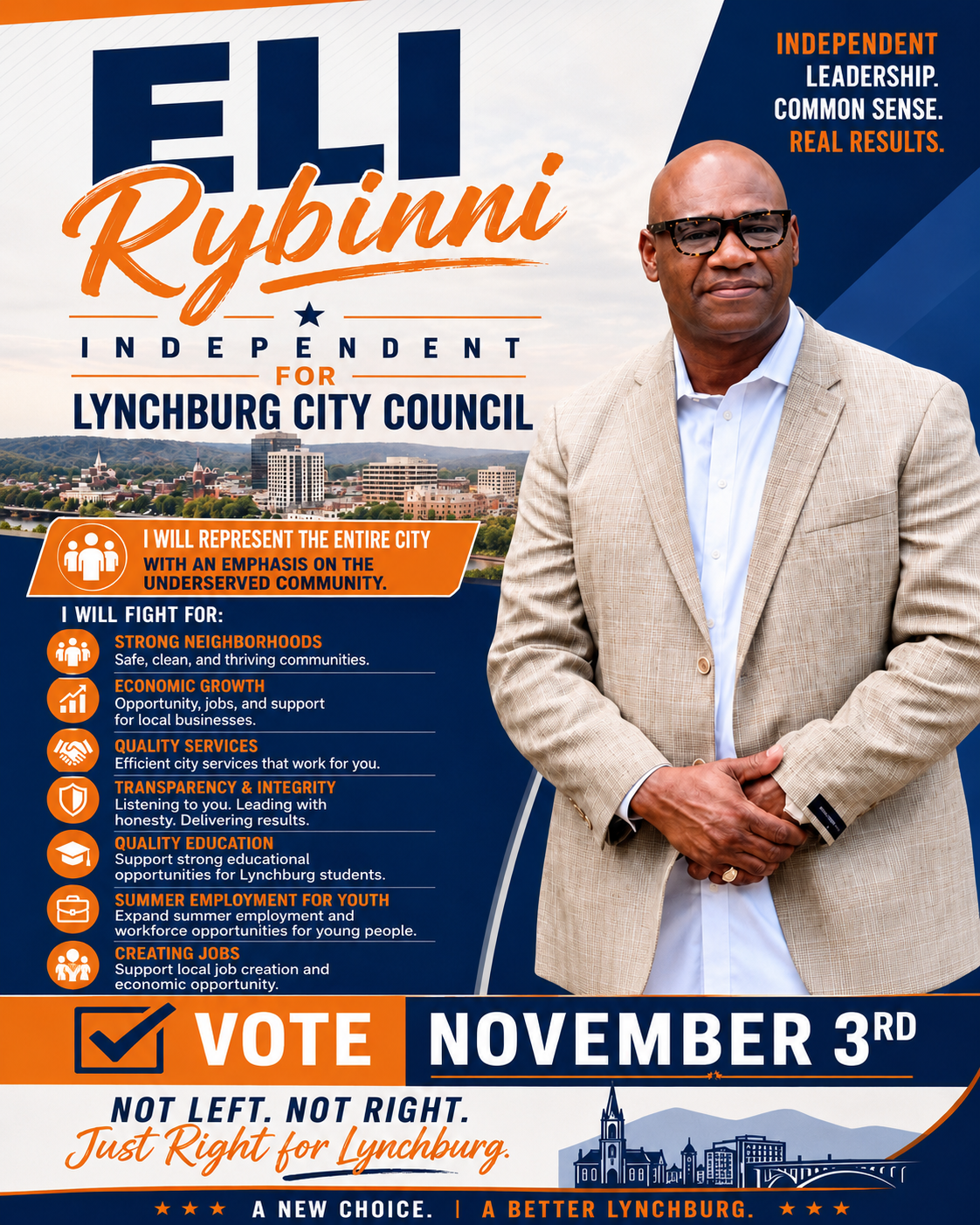
Education was one of the most detailed parts of the conversation.
Rybinni raised concerns about student achievement, literacy, racial disparities, mentorship and teacher recruitment.
He called for more role models for students, stronger conflict-resolution education, greater exposure to Black history and more career pathways beyond the traditional four-year college route.
He also placed significant responsibility on parents.
Rybinni repeatedly argued that schools cannot be expected to correct every problem that begins at home.
He said parents should play a larger role in discipline, communication, media exposure, life skills and educational preparation.
That position places responsibility on both institutions and families rather than assigning blame to one side.
Crime Policy Focuses on Prevention, Not Police Alone
Public safety was another major theme.
Rybinni said he supports the Lynchburg Police Department but does not believe law enforcement can solve crime by itself.
His approach centers on partnerships between police, churches, nonprofits, neighborhood organizations and people with firsthand experience of crime, addiction, homelessness and incarceration.
He referred to these individuals as “credible messengers.”
The concept is based on the idea that people who have lived through certain experiences may be able to reach residents who are less responsive to traditional institutions.
Rybinni said he would support funding community-based prevention efforts alongside police services.
His broader argument is that reducing crime requires attention to employment, housing, addiction, education and family stability.
The Flock Camera Debate Shows a Shift in His Position
The interview also addressed Lynchburg’s temporary pause of its Flock automatic license-plate recognition cameras.
Rybinni said he initially supported camera technology as a public-safety tool but changed his position after hearing concerns about surveillance, data collection and privacy.
He now opposes the use of the Flock system.
He drew a distinction between privately controlled neighborhood security cameras and larger government or third-party surveillance systems.
The issue reflects a larger policy tension facing cities across the country: how much surveillance residents are willing to accept in exchange for potential public-safety benefits.
Jobs and Skilled Trades Are Central to His Youth Strategy
Rybinni repeatedly returned to employment as a crime-prevention and youth-development tool.
He advocated for summer jobs, apprenticeships, skilled trades and hands-on career exposure.
Electrical work, plumbing, HVAC, roofing and painting were among the trades discussed.
His argument is that young people need realistic pathways to income and independence, not simply warnings about the consequences of bad choices.
He also emphasized entrepreneurship and practical career education.
For Rybinni, employment is not only an economic issue. It is part of his public-safety strategy.
Housing Proposals Focus on Stability, Not Just Shelter
Rybinni also outlined ideas for using vacant and deteriorated properties to expand affordable housing.
He said rehabilitation projects could provide more stable housing for working families while also improving neighborhoods.
His proposal includes additional support such as employment assistance, parenting education and financial responsibility.
He also questioned how the term “affordable housing” is defined.
His position is that housing should be evaluated relative to a resident’s actual income rather than treated as a single price point.
Homelessness Requires More Than a Bed
On homelessness, Rybinni argued that shelters alone are not enough.
He called for a coordinated approach that includes addiction treatment, employment assistance, benefits, housing and peer support.
He said formerly homeless people could play a role in outreach because of their direct experience.
The same philosophy appears throughout his platform: people closest to a problem should be included in solving it.
Rehabilitation and Accountability Can Exist Together
Rybinni also addressed people returning from incarceration.
He said offenders should be held accountable for their actions, but he also argued that incarceration should include preparation for reentry.
That preparation, he said, should include GED programs, job readiness, conflict resolution, treatment and employment assistance.
He warned that repeatedly denying employment and housing to people with criminal records can increase the likelihood of reoffending.
His position is not that consequences should disappear, but that punishment without rehabilitation does little to improve long-term public safety.
His Budget Approach Is Clear in Principle, Less Detailed in Practice
When pressed on city spending, Rybinni argued that more investment in prevention could reduce future public-safety costs.
He said savings from lower crime could eventually be redirected toward schools, housing, youth programs and teacher pay.
However, he did not outline specific budget cuts or a detailed funding plan during the interview.
That leaves an important question for voters.
Many of his proposals depend on grants, partnerships and new or redirected funding.
The next step is determining how those ideas would fit within Lynchburg’s actual budget and legal authority.
The Candidate Says Results Should Be Measured
One of Rybinni’s recurring themes was measurable action.
He suggested that programs such as youth mentorship, summer employment, housing rehabilitation, reentry services and credible-messenger outreach could begin as pilots.
The city, he said, should then evaluate results after six months or a year.
That emphasis on measurement may ultimately be one of the clearest standards by which voters judge his platform.
If a program is funded, what changed?
If money is spent, what improved?
If a promise is made, what result should residents expect?
A Campaign Focused on Neglected Communities, but Citywide Representation
Although Rybinni frequently discussed Black neighborhoods and underserved communities, he said his campaign is not based on race.
He said he wants voters to judge him on his record and ability to serve.
As an at-large candidate, he said he would represent residents across Lynchburg, including people of different races, backgrounds and identities.
His argument is that investing in the city’s most neglected areas benefits Lynchburg as a whole.
The Larger Question for Voters
The interview did not produce agreement on every issue, nor was that the purpose.
Rybinni expressed firm positions on Flock cameras, school funding, property taxes, affordable housing, artificial intelligence, data centers, youth programs and transparency.
Some of those positions are likely to appeal to voters.
Others will invite questions.
That is what political interviews should do.
The purpose of The Spotlight Insider is not to tell people who deserves their vote.
It is to give candidates space to explain what they believe, challenge them on how those ideas would work and give voters enough information to make their own decision.
Rybinni’s central argument is that Lynchburg needs fewer promises and more visible results.
The question for voters is whether his proposals are practical, fundable and achievable.
And beyond the campaign itself, there is another question worth considering:
What does meaningful change actually require from elected leaders, institutions and the people who live in the communities they serve?
Watch the full conversation with Eli Rybinni, also known as Shawn Hunter, on The Spotlight Insider, hosted by Johnathan Smith, aka TeflonJohn, an Impryze LLC Production.
Then decide for yourself.
See Who’s Been Shinning Near You



In this episode of The Spotlight Insider, host Johnathan “TeflonJohn” Smith is joined by Randall Calloway, Board Chair, and Robin Oyster, Admissions Coordinator of the UP Foundation. They discuss how the foundation supports individuals facing mental health and substance use challenges through judgment-free, holistic programs that foster recovery and community healing in Lynchburg, VA.
Join Johnathan “TeflonJohn” Smith with guests Randall Calloway and Robin Oyster as they highlight the UP Foundation’s impactful work in Lynchburg, Virginia. Learn about their mission to support youth and adults dealing with mental health and addiction through counseling, sober living homes, and youth empowerment initiatives. Discover how the foundation combats stigma, provides accessible care, and restores families and communities. Hear inspiring stories of recovery fueled by empathy, structure, and community support.