The Apology Means Nothing If the Pattern Stays the Same

An apology can sound beautiful.
It can sound sincere.
It can come with tears, emotion, long text messages, late-night phone calls, promises, explanations, and just enough vulnerability to make you believe things might finally be different.
But here is the truth nobody wants to say out loud:
An apology means nothing if the pattern stayed the same.
Some people are not sorry because they hurt you.
They are sorry because you reacted.
They are sorry because you pulled away.
They are sorry because the consequences finally reached them.
They are sorry because your silence made them uncomfortable.
They are sorry because they felt you creating distance and realized they might lose access to you.
But being sorry in the moment is not the same as being changed in the future.
And too many people are giving full access back to people who only offered temporary remorse.
Words Are Easy When Consequences Show Up

Anybody can say, “I am sorry.”
Anybody can say, “I did not mean it.”
Anybody can say, “I will do better.”
Anybody can say, “That was not my intention.”
Anybody can say, “I know I hurt you.”
But words become cheap when they are not followed by action.
That is where a lot of people get trapped.
They hear the apology and immediately want to believe the best. They want to believe the person finally understands. They want to believe the tears mean transformation. They want to believe the pain is over because the conversation sounded different this time.
But you cannot confuse an emotional moment with real maturity.
Sometimes people know how to apologize just enough to reset the relationship without actually changing the behavior that damaged it.
They say sorry.
You soften.
They get access again.
Then the same pattern starts over.
Same disrespect.
Same inconsistency.
Same broken promises.
Same lack of accountability.
Same excuses.
Same behavior with better wording.
And eventually, you start realizing the apology was not the end of the cycle.
It was part of the cycle.
A Changed Tone Is Not a Changed Person

Some people do not change.
They just learn how to sound better after they hurt you.
They learn what words calm you down.
They learn what emotions make you feel guilty.
They learn how to say the right thing when they feel you pulling away.
They learn how to sound humble without becoming accountable.
That is why you have to pay attention beyond the apology.
Did their behavior change?
Did their consistency change?
Did their respect change?
Did their communication change?
Did their effort change?
Did their attitude change when you set boundaries?
Did they take responsibility without blaming you for how you responded to their actions?
Because a changed tone is not the same as a changed person.
Some people can cry and still repeat the same behavior.
Some people can apologize and still avoid accountability.
Some people can say they love you and still keep hurting you in the same place.
That does not mean every apology is fake.
But it does mean every apology needs to be tested by time.
Stop Accepting Apologies That Come With No Accountability

An apology without accountability is just damage control.
Real accountability sounds different.
It does not just say, “I am sorry you feel that way.”
It says, “I understand what I did.”
It does not just say, “That was not my intention.”
It says, “Even if that was not my intention, I see how my actions affected you.”
It does not just say, “Let’s move on.”
It says, “What do I need to do differently so this does not keep happening?”
Real accountability does not rush your healing.
It does not pressure you to get over it.
It does not make you feel guilty for needing time.
It does not turn the conversation around and make you responsible for their discomfort.
Some people apologize because they want forgiveness without change.
They want peace without repair.
They want access without consequences.
They want you to stop being hurt before they have done the work to stop being harmful.
But you are not required to accept an apology that comes with the same pattern attached to it.
You can forgive someone and still recognize they are not safe for the same level of access.
Forgiveness Does Not Mean Restoring Access

This is where people get confused.
Forgiveness is not always the same as restoration.
You can forgive someone and still not give them the same place in your life.
You can forgive someone and still create distance.
You can forgive someone and still decide that the relationship needs boundaries.
You can forgive someone and still require changed behavior before trust is rebuilt.
Forgiveness may release the bitterness from your heart, but it does not erase the wisdom you gained from the experience.
Some people want forgiveness to mean everything goes back to normal.
But sometimes normal was the problem.
Normal was you tolerating disrespect.
Normal was you accepting excuses.
Normal was you carrying the emotional weight.
Normal was you giving chances to someone who kept mishandling them.
Normal was you pretending you were okay because you did not want conflict.
So no, everything does not have to go back to normal.
Sometimes the apology is accepted, but the access still changes.
And that is not bitterness.
That is growth.
Repeated Patterns Reveal What Words Try to Hide

People can say anything.
Patterns tell the truth.
A person’s pattern will show you what their apology is made of.
If they apologize but keep doing the same thing, that is information.
If they apologize but get mad when you bring up the hurt, that is information.
If they apologize but only change for a week, that is information.
If they apologize but expect you to immediately trust them again, that is information.
If they apologize but still blame everybody else, that is information.
If they apologize but never create a plan to do better, that is information.
Patterns reveal priorities.
People make time for what matters to them.
People change what they truly want to change.
People protect what they truly value.
So when someone keeps hurting you in the same way after claiming they are sorry, you have to ask yourself a hard question:
Are they really struggling to change, or are they comfortable because I keep staying?
That question may sting.
But sometimes the sting is what wakes you up.
Love Is Not Proven By Apology, It Is Proven By Adjustment
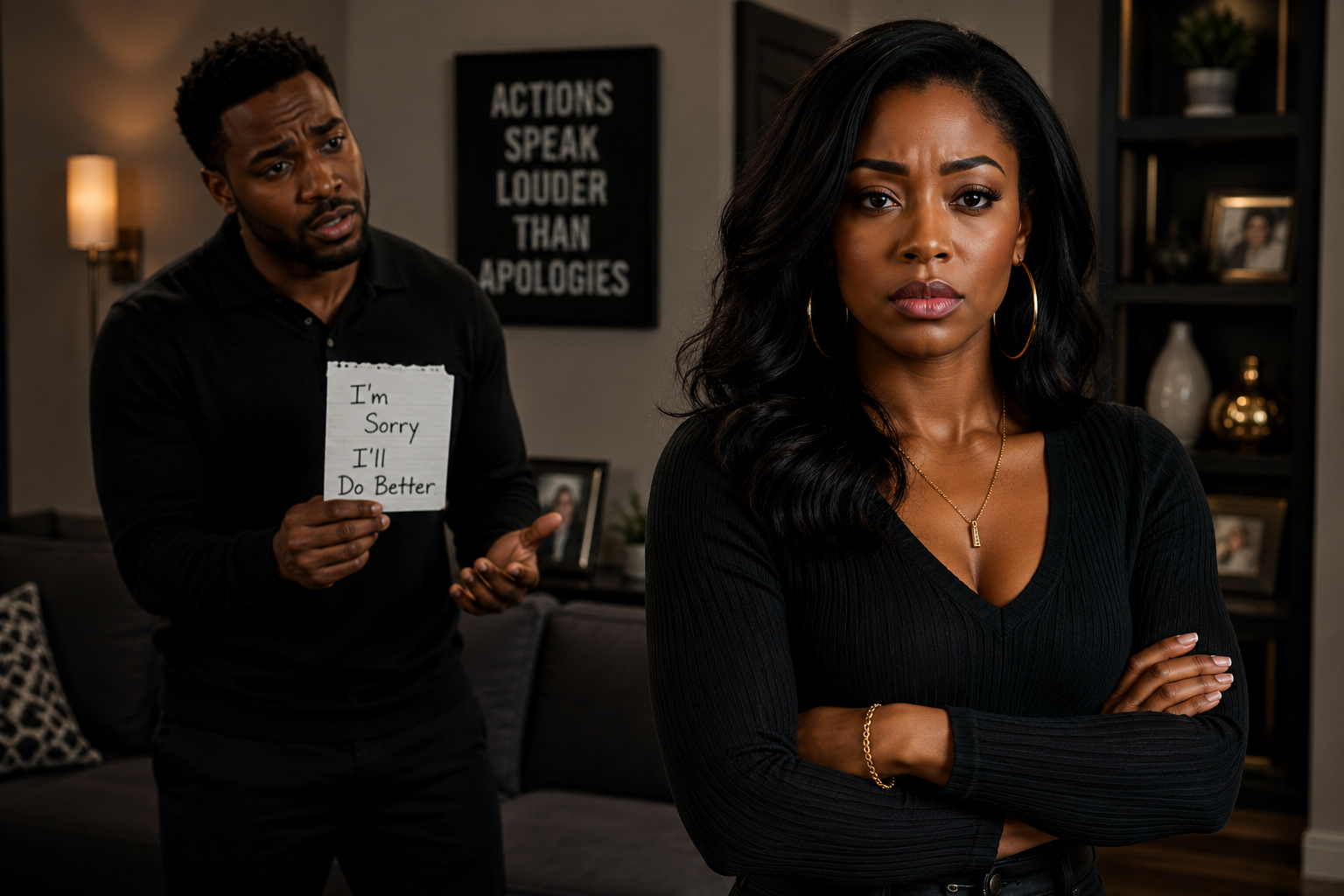
Love is not just saying, “I am sorry.”
Love is adjusting.
Love listens.
Love learns.
Love pays attention.
Love does not keep stepping on the same wound and then act surprised when you bleed.
Love does not make you beg for basic respect.
Love does not keep creating the same pain and calling your reaction the problem.
Love does not require you to lower your standards just to keep the relationship alive.
When someone truly values you, they do not just apologize for hurting you.
They become intentional about not hurting you the same way again.
That is the difference.
The apology may open the conversation, but changed behavior rebuilds the trust.
Without change, the apology is just noise.
Some People Want Credit for Apologizing, Not Responsibility for Changing

This is the part that will make some people uncomfortable.
Some people want praise for apologizing.
They want you to acknowledge that they said sorry.
They want you to move on because they admitted they were wrong.
They want you to stop talking about the damage because they finally addressed it.
But an apology is not the finish line.
It is the starting point.
Saying sorry does not automatically repair what was broken.
It does not automatically rebuild trust.
It does not automatically erase the nights you cried, the times you felt ignored, the moments you questioned yourself, or the emotional damage created by repeated behavior.
If someone breaks something valuable, they cannot just say, “My bad,” and expect everything to be whole again.
Repair requires work.
And if someone is only willing to apologize but not willing to do the work, they are not pursuing reconciliation.
They are pursuing relief from consequences.
Stop Letting Familiar Pain Feel Like Love

One reason people keep accepting the same apology is because the pattern is familiar.
You know how this goes.
They hurt you.
You pull back.
They apologize.
You soften.
Things feel good for a little while.
Then the same behavior returns.
It becomes a rhythm.
A painful rhythm, but still familiar.
And if you are not careful, familiarity can start feeling like love.
But love should not keep leaving you emotionally exhausted.
Love should not keep requiring you to explain the same pain over and over.
Love should not keep making you question if your feelings matter.
Love should not keep asking you to stay in something that keeps wounding you.
Just because you know the pattern does not mean you have to keep living in it.
At some point, you have to stop asking, “Why do they keep doing this?”
And start asking, “Why do I keep giving the same behavior the same access?”
That question is not about blaming yourself.
It is about taking your power back.
Changed Behavior Takes Time, But It Also Takes Effort

Nobody is perfect.
People make mistakes.
People have bad days.
People grow at different speeds.
People may need time to unlearn unhealthy patterns.
So this is not about expecting perfection from people.
It is about expecting effort.
There is a difference between someone who is trying and someone who is repeating.
Someone who is trying may stumble, but they stay honest.
Someone who is trying may mess up, but they take responsibility quickly.
Someone who is trying does not punish you for being hurt.
Someone who is trying asks questions, listens, learns, and makes real adjustments.
But someone who is repeating will keep giving you the same apology with no evidence of growth.
They will keep asking for grace while refusing discipline.
They will keep saying they are working on it while doing nothing different.
They will keep expecting patience without producing progress.
Grace is beautiful.
But grace was never meant to become permission for someone to keep hurting you.
You Can Accept the Apology and Still Change the Relationship

Sometimes the healthiest response is not anger.
It is adjustment.
You do not always have to argue.
You do not always have to explain.
You do not always have to prove how hurt you are.
Sometimes you simply accept what the pattern has shown you and move differently.
You can say:
“I hear your apology, but I need to see change.”
“I forgive you, but I cannot keep giving access to the same behavior.”
“I am not trying to punish you, but I have to protect my peace.”
“I need consistency, not just regret.”
“I cannot keep restarting a cycle that keeps hurting me.”
That is not being cold.
That is being clear.
Because clarity is necessary when people keep mistaking your forgiveness for permission.
The Pattern Is the Message

At some point, the pattern becomes the message.
Not the apology.
Not the explanation.
Not the promise.
Not the tears.
The pattern.
If someone keeps choosing the same behavior after they know it hurts you, that is a message.
If someone keeps apologizing but never changing, that is a message.
If someone only acts concerned when you are finally done, that is a message.
If someone respects your boundaries only when they fear losing access, that is a message.
Do not ignore the message because you like the person.
Do not ignore the pattern because the apology sounded good.
Do not keep handing your peace back to someone who only protects it when they are about to lose you.
Your peace is too valuable to keep gambling on apologies with no action behind them.
Final Thought

The apology means nothing if the pattern stayed the same.
That does not mean people cannot change.
They can.
But real change will show up in behavior, not just words.
Real change will show up in consistency, not just emotion.
Real change will show up when they are no longer trying to win you back, but genuinely trying to grow.
So pay attention.
Pay attention to the pattern after the apology.
Pay attention to whether they respect your boundaries.
Pay attention to whether they take responsibility without making you the villain.
Pay attention to whether they change when there are no consequences forcing them to.
Because you deserve more than a beautiful apology attached to the same painful cycle.
You deserve respect.
You deserve consistency.
You deserve peace.
And you deserve relationships where the apology is not just something people say to keep you around.
It is something they live out by doing better.
Have you ever accepted an apology, only to realize the pattern never changed?
Get More Inspiration